
What Truck Do You Need to Pull a Dump Trailer?
What truck you need to pull a dump trailer: half-ton vs. 3/4-ton vs. 1-ton, payload vs. towing capacity, hitch ratings, and real combos for 7k to 20k+ trailers.
By Strank Trailers11 min read
The short version
- Towing capacity is rarely the limit. Payload, rear axle rating, hitch receiver rating, and GCWR usually run out first.
- Tongue weight counts against your truck's payload. A loaded 14,000 lb dump trailer puts roughly 1,400 to 2,100 lb on the hitch, which is more than many half-tons can carry once you add the driver and gear.
- As a rule of thumb: half-ton for 7k trailers, 3/4-ton for 10k, 3/4-ton minimum and 1-ton preferred for 14k, 1-ton for 16k, and a 1-ton dually or medium-duty truck for 20k-plus goosenecks.
- Read the label on your hitch receiver. Ford's 2025 F-150 towing guide says not to exceed 5,000 lb of trailer without a weight-distribution system.
- Weigh the loaded rig on a certified scale and compare each axle and the total against the door sticker and towing guide.
On this page
The short answer: a half-ton can handle a small 7,000 lb dump trailer if it's properly equipped. A 3/4-ton is the right match for 10,000 lb trailers and the practical minimum for 14,000 lb. A 1-ton is the comfortable choice for 14,000 to 16,000 lb. 20,000 lb-plus gooseneck dump trailers call for a 1-ton dually or a medium-duty truck.
The number that limits you is rarely the advertised towing capacity. It's usually payload, rear axle rating, hitch rating, or GCWR, and a dump trailer can push you past those faster than almost any other trailer.
Here's how to read each rating, why tongue weight matters so much, and which truck fits which trailer.
The ratings that decide what you can tow
Every truck carries several ratings, and you have to stay under all of them at once. The lowest one sets your real limit.
| Rating | What it means | Where to find it |
|---|---|---|
| Towing capacity | Max loaded trailer weight for that exact configuration | Manufacturer towing guide, owner's manual |
| Payload | Weight the truck can carry: people, cargo, and tongue weight | Tire and loading label on the door jamb |
| GVWR | Max loaded weight of the truck itself | Certification label on the door jamb |
| Rear GAWR | Max weight on the rear axle | Certification label on the door jamb |
| GCWR | Max weight of truck and trailer combined | Towing guide, owner's manual |
| Receiver rating | Max trailer and tongue weight for the hitch | Label on the receiver |
The one people forget is payload. The tongue weight of the trailer sits on the truck, so every pound of it comes out of payload, the same as passengers, a toolbox, or a fuel tank in the bed.
Tongue weight on a bumper-pull trailer typically runs 10 to 15% of the loaded trailer weight. Ford's towing guides use 10% for conventional trailers and 15% for fifth-wheel and gooseneck kingpin weight. Gooseneck pin weight in the real world often runs 15 to 25%. Dump trailers often run toward the high end, because material tends to pile up at the front of the box. Our guide to loading a dump trailer covers how to keep it in range.
For a refresher on how these ratings relate, see GVWR, payload, and empty weight explained.
Half-ton vs. 3/4-ton vs. 1-ton vs. medium duty
The "ton" names are old shorthand that no longer match actual capacity. Here's what each class looks like today. Ratings vary a lot by cab, bed, engine, axle ratio, and trim, so treat these as typical ranges and check the spec for the exact truck.
| Class | Examples | Typical GVWR | Typical payload | Realistic dump trailer |
|---|---|---|---|---|
| Half-ton | F-150, Silverado 1500, Ram 1500, Tundra | About 6,000 to 7,900 lb | About 1,400 to 2,400 lb | 7,000 lb GVWR |
| 3/4-ton | F-250, Ram 2500, Silverado/Sierra 2500HD | About 10,000 to 11,500 lb | About 2,500 to 4,000+ lb | 10,000 to 14,000 lb |
| 1-ton | F-350, Ram 3500, Silverado/Sierra 3500HD | About 11,000 to 14,000+ lb | About 3,500 to 8,000 lb | 14,000 to 16,000 lb bumper pull; 20,000 lb+ gooseneck (dually) |
| Medium duty (Class 4 to 5) | F-450/F-550, Ram 4500/5500, Silverado 4500HD/5500HD | 14,001 to 19,500 lb | Varies with body | 20,000 lb+ gooseneck, daily heavy hauling |
A few points of reference from manufacturer and dealer materials for 2026: Ford lists the F-150's best-case payload at 2,440 lb and best-case towing at 13,500 lb. Those come from different configurations, and you can't get both on the same truck. Heavy-duty diesel 3/4-tons from the major brands are commonly rated near 20,000 lb conventional towing in their best configurations. Always confirm against the current spec sheet for the exact truck.
Gas or diesel?
A diesel gives you more low-end torque, better control on loaded grades, and usually an exhaust brake, which saves your service brakes on long descents. It's also heavier. The extra engine weight comes straight out of payload, so a diesel 3/4-ton can have hundreds of pounds less payload than the same truck with a gas engine. For short local hauls on flat ground, a gas heavy-duty truck is often enough. For loaded highway runs, hills, or 14,000 lb-plus trailers every day, most operators go diesel.
Hitch receiver classes and ratings
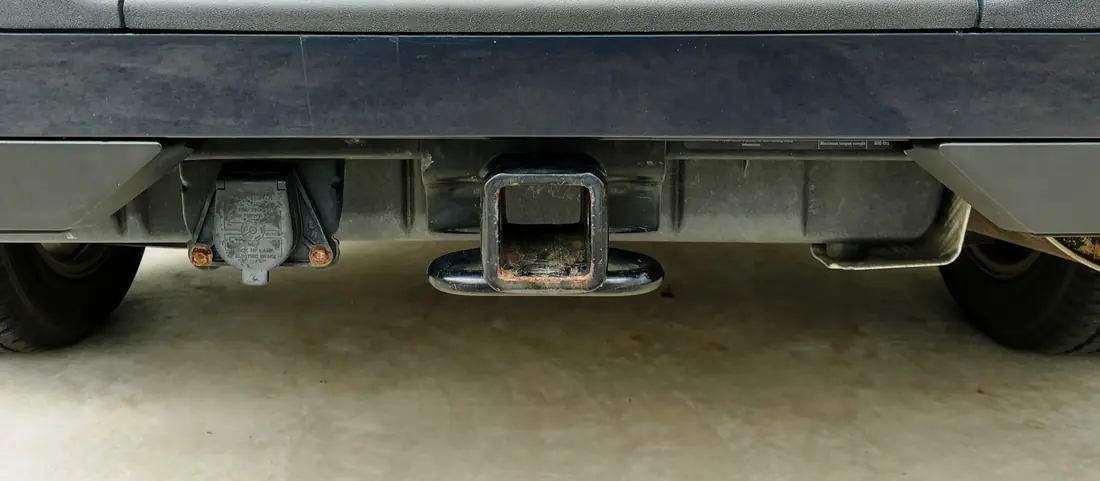
Receiver hitches are sold by class, but the class is only a rough guide. The rating that counts is the label on your receiver. The ball mount, the ball, and the trailer coupler each carry their own ratings too, and the lowest one in the chain sets your limit.

| Hitch class | Typical receiver opening | Typical max trailer weight | Typical max tongue weight |
|---|---|---|---|
| Class III | 2 in. | Up to about 8,000 lb | Up to about 800 lb |
| Class IV | 2 in. | Up to about 10,000 lb | Up to about 1,000 lb |
| Class V / heavy duty | 2 in., 2-1/2 in., or 3 in. | Roughly 12,000 to 20,000+ lb, by manufacturer | Roughly 1,200 to 2,700+ lb |
| Gooseneck (bed-mounted ball) | Ball in the truck bed | Commonly 25,000 to 30,000+ lb | Per hitch and truck rating |
Hitch makers rate their products differently, so these ranges are approximate.
Labels often list two ratings: weight-carrying, where all the tongue weight sits on the ball, and weight-distributing, which uses a hitch with spring bars that spread some of the tongue weight to the truck's front axle and the trailer's axles. The gap between them can be large. Ford's 2025 F-150 towing guide lists the standard receiver at 5,000 lb with a 500 lb tongue load for weight-carrying, and 13,500 lb with a 1,350 lb tongue load for weight-distributing. It also says plainly: "Do not exceed trailer weight of 5,000 lbs. when towing without a weight-distribution system." Other brands set different limits, so read your own receiver.
That matters for dump trailers. They're usually towed weight-carrying, on a ball or pintle, without a weight-distribution setup. Weight-distribution hitches can be fitted to some bumper-pull dump trailers, but they're less common on heavy equipment trailers. A weight-distribution hitch also doesn't raise the truck's GVWR, GCWR, or the receiver's maximum ratings.
Why a half-ton struggles with a loaded 14k dump trailer
On paper, a half-ton rated to tow 13,500 lb looks close enough to a 14,000 lb trailer. In practice, it usually isn't. Here's the math on a common example.
The trailer: a 14,000 lb GVWR dump trailer that weighs about 4,500 to 5,500 lb empty and is loaded to its rating.
The tongue weight, at different percentages of 14,000 lb:
| Tongue weight % | Tongue weight on the truck |
|---|---|
| 10% | 1,400 lb |
| 12% | 1,680 lb |
| 15% | 2,100 lb |
The truck: a crew-cab 4x4 half-ton with a door-sticker payload of 1,700 lb, which is a common figure for a well-optioned truck. Subtract a 200 lb driver, a 180 lb passenger, 150 lb of tools and gear, and a 40 lb ball mount. That leaves about 1,130 lb of payload for tongue weight.
Even at a light 10%, the trailer puts 270 lb more on the truck than it can legally carry. At a more realistic 12 to 15%, you're 550 to 970 lb over. The rear axle is also likely to go past its GAWR, because tongue weight sits behind the axle and also lifts weight off the front axle, which costs you steering and braking grip.
It gets worse from there:
- The receiver. On an F-150, anything over 5,000 lb of trailer requires a weight-distribution system under Ford's guide. A loaded 14k dump trailer is nearly three times that.
- GCWR. A half-ton crew cab weighs roughly 5,000 to 5,500 lb at the curb. Add people, gear, and a 14,000 lb trailer, and you're near 20,000 lb combined. That's at or past the GCWR of every F-150 configuration in Ford's 2025 towing guide, and well past most of them.
- The advertised towing number. Best-case figures are calculated for a specific, lightly optioned configuration with only a 150 lb driver and passenger (Ford's footnote), and under the SAE J2807 standard. Your truck, with your options, will be rated lower.
A half-ton can physically pull the trailer down the road. It just can't do it within its ratings, and the ratings exist because of braking, cooling, tires, and frame strength.
Real-world truck and dump trailer combinations
The table below pairs common dump trailer ratings with practical trucks. Empty weights are rough typical ranges for steel dump trailers and vary a lot by build, so check the trailer's actual scale weight. Box size and GVWR don't always line up, so go by the GVWR on the VIN plate.
| Trailer GVWR | Typical sizes | Loaded tongue weight (10 to 15%) | Minimum practical truck | Comfortable truck |
|---|---|---|---|---|
| 7,000 lb | 5x10, 6x10 | 700 to 1,050 lb | Half-ton, within receiver and payload limits | 3/4-ton |
| 10,000 lb | 6x12, 7x12 | 1,000 to 1,500 lb | 3/4-ton | Diesel 3/4-ton or 1-ton |
| 14,000 lb | 7x14 | 1,400 to 2,100 lb | 3/4-ton | 1-ton |
| 16,000 lb | 7x16 | 1,600 to 2,400 lb | 1-ton | 1-ton dually |
| 20,000 lb+ gooseneck | 7x16 to 8x20 | 3,000 to 5,000 lb pin weight (15 to 25%) | 1-ton dually | Medium duty |
7,000 lb dump trailers
These are the small utility dump trailers homeowners, property managers, and small landscapers use. A properly equipped half-ton can work. Check the receiver label's weight-carrying limit first, because some half-ton receivers need a weight-distribution system above about 5,000 lb. A 3/4-ton handles a 7k trailer without strain.
10,000 lb dump trailers
At 10,000 lb loaded, tongue weight reaches 1,000 to 1,500 lb, beyond what most half-tons should carry. A 3/4-ton is the right match. A trailer rated at 10,000 lb or less also keeps you out of federal Class A CDL territory behind any pickup.
14,000 lb dump trailers
This is the most common working size, and the one where truck choice matters most. A 3/4-ton is the practical minimum. Check that its door-sticker payload and rear GAWR leave room for 1,400 to 2,100 lb of tongue weight plus your crew and tools. A 1-ton gives you margin for heavier loads like wet dirt and gravel. Wet dirt and gravel weigh far more per cubic yard than mulch, and they get heavy fast.
16,000 lb dump trailers
Tongue weight can reach 2,400 lb, so a 1-ton is the realistic minimum. Some diesel 3/4-tons are rated to tow this much, but payload and rear axle ratings get tight. A 3/4-ton rated above 10,000 lb GVWR pulling a 16,000 lb trailer also crosses the 26,001 lb combined line for a Class A CDL in commercial use. See do you need a CDL to pull a dump trailer?
20,000 lb-plus gooseneck dump trailers
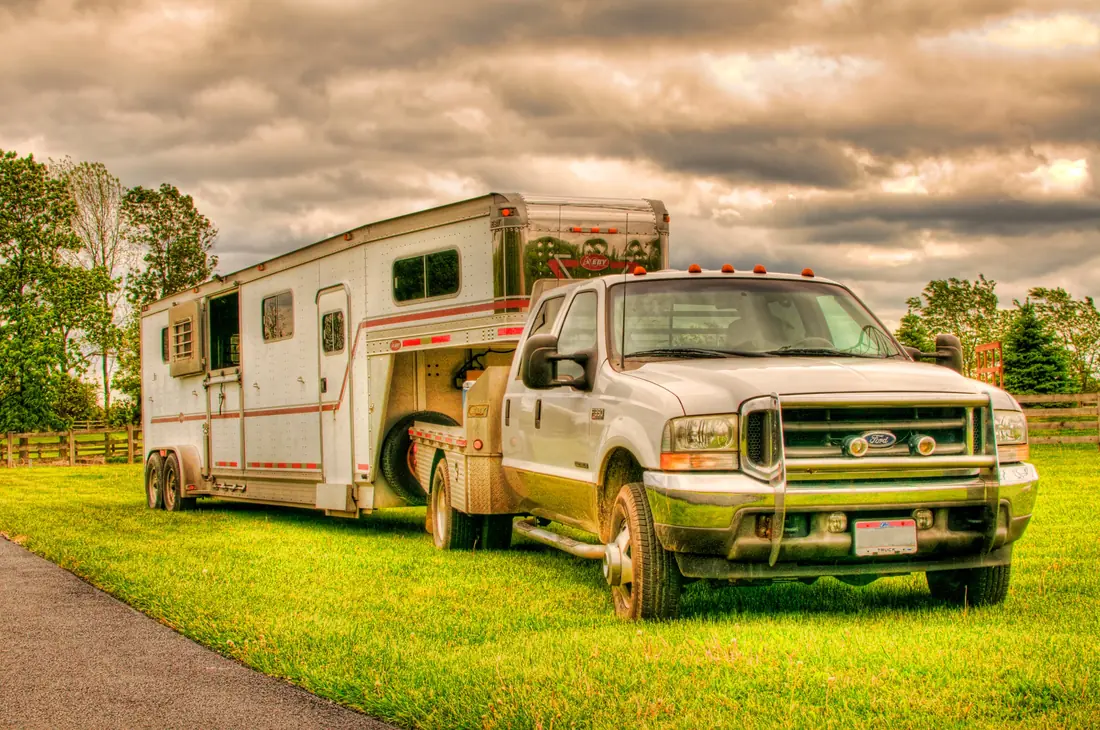
At this size, goosenecks are standard. The pin weight sits over or just ahead of the rear axle instead of behind the bumper, which suits heavy loads better. A 1-ton dually is the usual minimum. Medium-duty trucks such as an F-550 or Ram 5500 make sense for all-day hauling. Plan on a Class A CDL for commercial use with any pickup. Our guide to gooseneck vs. bumper pull dump trailers compares the two hitch styles.

How to check your own truck in five minutes
- Open the driver's door. Write down the payload figure on the tire and loading label, and the GVWR and rear GAWR from the certification label.
- Read the receiver label. Note both the weight-carrying and weight-distributing ratings, if listed.
- Look up GCWR for your exact engine, axle ratio, and cab in the manufacturer's towing guide for your model year.
- Estimate tongue weight at 10 to 15% of the trailer's loaded weight, or 15 to 25% for a gooseneck. Our load calculator can estimate loaded trailer weight for common materials.
- Subtract people, tools, fuel tanks, and the hitch from payload. If tongue weight doesn't fit in what's left, you need a bigger truck or a lighter load.
The bottom line
Match the truck to the trailer's loaded weight, not its empty weight or the truck's brochure towing number. Tongue weight against payload is where most half-ton and dump trailer combinations fail. The receiver label, rear axle rating, and GCWR are the next places to check. As a starting point: a half-ton for 7k, a 3/4-ton for 10k and as the minimum for 14k, a 1-ton for 14k to 16k, and a 1-ton dually or medium-duty truck for 20k-plus goosenecks. Then weigh the loaded rig to confirm. For the brakes that have to stop all that weight, see our guide to dump trailer brakes.
Frequently asked questions
Can a half-ton truck pull a dump trailer?
A properly equipped half-ton can handle a small 7,000 lb GVWR dump trailer if it stays within the truck's payload, receiver rating, and GCWR. Most half-tons are overmatched by a loaded 14,000 lb dump trailer, mainly because of tongue weight and payload.
Can a 3/4-ton truck pull a 14k dump trailer?
Yes, a properly equipped 3/4-ton is the usual minimum for a 14,000 lb dump trailer. Check that the door-sticker payload and rear axle rating can take 1,400 to 2,100 lb of tongue weight plus people and tools. A diesel 3/4-ton or a 1-ton gives more margin.
What truck do I need for a 16k dump trailer?
A 1-ton pickup, either single rear wheel or dually, is the realistic choice for a loaded 16,000 lb bumper-pull dump trailer. Some diesel 3/4-tons are rated to tow that much, but payload and rear axle ratings get tight, and the combined rating can push you into Class A CDL territory.
Do I need a dually to pull a dump trailer?
Not for most bumper-pull dump trailers up to 14,000 lb. A dually (dual rear wheel) truck earns its place with 20,000 lb-plus gooseneck dump trailers and heavy daily hauling, where its higher rear axle rating and stability matter.
What hitch class do I need for a dump trailer?
Match the receiver's labeled rating to the loaded trailer weight and tongue weight, not just the class number. Class IV receivers are typically rated around 10,000 lb, and heavier dump trailers need a Class V or heavy-duty receiver, pintle, or gooseneck hitch rated at or above the trailer's GVWR.
Share this guide
Link to this guide
Writing about dump trailers? You're welcome to quote this guide and link to it. Copy whichever format you need.
- URL
- https://stranktrailers.com/guides/what-truck-do-you-need-for-a-dump-trailer
- HTML link
- <a href="https://stranktrailers.com/guides/what-truck-do-you-need-for-a-dump-trailer">What Truck Do You Need to Pull a Dump Trailer?</a> (Strank Trailers)
- Citation
- Strank Trailers. "What Truck Do You Need to Pull a Dump Trailer?." stranktrailers.com, October 28, 2026. https://stranktrailers.com/guides/what-truck-do-you-need-for-a-dump-trailer
Keep reading
Ownership · 9 min read
How to Load a Dump Trailer
How to load a dump trailer safely: tongue weight targets, front-to-back placement, loading with a skid steer or excavator, material weights, GVWR, and tarping.
Specs · 10 min read
GVWR, Payload, and Empty Weight Explained
GVWR is the most a loaded trailer may weigh. Payload is GVWR minus empty weight. How to read the label, find real payload, and check tongue weight and GCWR.
Towing · 9 min read
Do You Need a CDL to Pull a Dump Trailer?
When a dump trailer requires a CDL: the federal 26,001 lb / 10,000 lb Class A rule, how GCWR is calculated, worked truck-and-trailer examples, and state rules.