
Material Weight Chart: Gravel, Dirt, Sand, Mulch, and More
Material weight chart in pounds and tons per cubic yard for gravel, dirt, sand, mulch, concrete, and debris, plus how many yards a dump trailer can haul.
By Strank Trailers10 min read
The short version
- Most gravel, sand, and dirt weigh 2,000 to 3,400 lb per cubic yard, so a typical 14,000 lb GVWR dump trailer carries only about 3 to 4 yards of them.
- Moisture matters: wet sand or wet topsoil can weigh 25 to 40 percent more than the same material dry.
- To find how many yards you can haul, divide the trailer's real payload (GVWR minus weighed empty weight) by the material's weight per yard.
- Light materials like mulch, wood chips, and mixed debris usually fill the box before they reach the weight limit.
- Published weights are averages. For anything close to your limit, weigh the load on a certified scale.
On this page
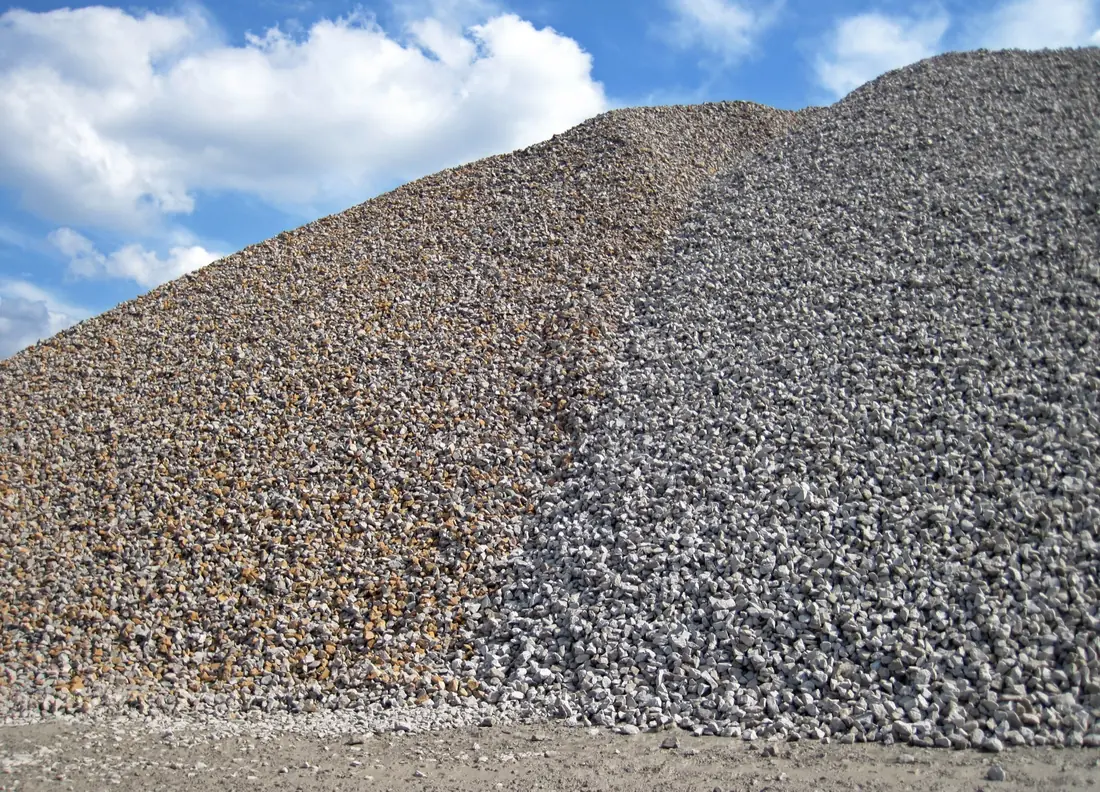
A cubic yard of gravel, sand, or dirt typically weighs between 2,000 and 3,400 lb (1 to 1.7 tons), depending on the material and how wet it is. Mulch and wood chips weigh a fraction of that, roughly 250 to 800 lb per yard, while broken concrete and brick land in between. The chart below gives approximate weights for more than two dozen common materials, with sources.
The reason this matters for dump trailer owners is simple: heavy materials hit your trailer's weight limit long before they fill the box. Knowing the weight per yard tells you how many yards you can legally haul, and how close you are to overloading your axles, tires, and hitch.
Material weight chart (pounds and tons per cubic yard)
All figures are approximate weights for loose material, the way it sits in a loader bucket or a trailer box. A short ton is 2,000 lb. Where sources disagree or the material varies widely, the chart shows a range.
Aggregates: gravel, stone, and sand
| Material | lb per cubic yard | tons per cubic yard | Notes |
|---|---|---|---|
| Gravel, dry (1/4 in to 2 in) | 2,550–2,850 | 1.28–1.43 | Caterpillar handbook loose values |
| Gravel, wet (1/4 in to 2 in) | about 3,400 | about 1.70 | Water fills the voids |
| Pit-run gravel | about 3,250 | about 1.63 | Includes sand and fines |
| Crushed stone (#57, 3/4 in) | 2,500–2,900 | 1.25–1.45 | Suppliers often use 1.4 tons/yd |
| Pea gravel | 2,500–2,800 | 1.25–1.40 | Rounded, uniform stone |
| River rock | 2,400–2,800 | 1.20–1.40 | Larger stones leave more voids |
| Sand, dry | about 2,400 | about 1.20 | Caterpillar handbook |
| Sand, damp | about 2,850 | about 1.43 | Typical stockpile condition |
| Sand, wet | about 3,100 | about 1.55 | Can run higher when saturated |
Soils: topsoil, fill dirt, and clay
| Material | lb per cubic yard | tons per cubic yard | Notes |
|---|---|---|---|
| Topsoil, dry | 1,600–2,200 | 0.80–1.10 | Caterpillar lists 1,600 lb loose |
| Topsoil, wet | 2,200–2,700 | 1.10–1.35 | Heavier after rain |
| Fill dirt / common earth, loam | about 2,100 | about 1.05 | Loose, low clay content |
| Fill dirt, dry packed earth | about 2,550 | about 1.28 | Caterpillar handbook |
| Fill dirt, wet excavated | about 2,700 | about 1.35 | Caterpillar handbook |
| Clay, dry | about 2,500 | about 1.25 | Caterpillar handbook |
| Clay, wet or natural bed | about 2,800 | about 1.40 | Sticky and slow to dump |
Landscape and organic materials
| Material | lb per cubic yard | tons per cubic yard | Notes |
|---|---|---|---|
| Mulch (shredded bark), dry | 400–800 | 0.20–0.40 | Varies by wood type |
| Mulch, wet | 800–1,000+ | 0.40–0.50+ | Absorbs a lot of water |
| Wood chips, dry | about 245 | about 0.12 | EPA factor |
| Wood chips, green | about 475 | about 0.24 | EPA factor |
| Compost, screened | 800–1,200 | 0.40–0.60 | About 1,000 lb at 50% moisture |
| Compost, very wet | 1,500+ | 0.75+ | Per Oregon State Extension |
| Leaves, loose | 250–500 | 0.13–0.25 | EPA factor |
| Mixed yard waste, uncompacted | about 250 | about 0.13 | EPA factor |
| Branches and brush | about 130 | about 0.07 | EPA factor, loosely loaded |
Demolition debris, masonry, and junk
| Material | lb per cubic yard | tons per cubic yard | Notes |
|---|---|---|---|
| Concrete, solid (in place) | about 4,050 | about 2.0 | Before it is broken up |
| Concrete, broken | 1,400–2,700 | 0.70–1.35 | Depends on piece size and packing |
| Asphalt, solid (in place) | 4,050–4,140 | 2.0–2.1 | Before it is broken up |
| Asphalt, broken chunks | 1,400–2,700 | 0.70–1.35 | Similar to broken concrete |
| Asphalt millings (RAP) | 2,500–3,000 | 1.25–1.50 | One supplier lists 2,800 lb for 1 in minus |
| Brick, broken or loose | 2,000–3,000 | 1.0–1.5 | Solid brick is about 3,240 lb/yd |
| Roofing shingles, tear-off | about 730 loose | about 0.37 | Packs heavier; see note below |
| Drywall scrap | 450–500 | 0.23–0.25 | EPA and LEED factors |
| Mixed C&D debris | 400–500 | 0.20–0.25 | Much heavier if masonry-rich |
| Scrap lumber | 170–300 | 0.09–0.15 | EPA and LEED factors |
| Household junk, uncompacted | 250–300 | 0.13–0.15 | EPA factor for mixed trash |
Other reference weights
| Material | lb per cubic yard | tons per cubic yard | Notes |
|---|---|---|---|
| Snow, fresh | 80–570 | 0.04–0.29 | Light powder to wet and heavy |
| Snow, packed or slushy | 600–1,200+ | 0.30–0.60+ | Highly variable |
| Ice | about 1,540 | about 0.77 | Upper limit for snow |
| Water | about 1,685 | about 0.84 | 202 gallons at 8.34 lb/gal |
Why weights vary so much
Three things drive most of the spread in the chart.
Moisture. Water weighs about 1,685 lb per cubic yard and fills the voids between particles. Caterpillar's figures put dry loose sand at 2,400 lb per yard and wet sand at 3,100, a 29 percent jump. A load of topsoil or mulch picked up after a week of rain can be several hundred pounds per yard heavier than the same pile in August.
Particle shape and size. Uniform rounded stone like pea gravel or river rock leaves more air space than crushed stone with angular faces and fines. Material with a mix of sizes, like pit-run gravel or crusher run, packs tighter and weighs more.
Loose vs. bank vs. compacted. Soil in the ground (bank measure) is denser than the same soil after it is dug up. Caterpillar lists topsoil at 2,300 lb per yard in the bank but 1,600 lb loose. When you haul, you are dealing with loose yards. When a contractor measures a hole, they are measuring bank yards, and the excavated dirt will take up 20 to 30 percent more room in your trailer.
When you buy material by the ton but think in yards, ask the yard or quarry for their conversion factor. They weigh their own stockpiles on a certified scale, so their number beats any chart, including this one.
How many yards can a dump trailer carry?
Your trailer is limited by two things: weight and volume. Whichever limit you hit first is your real capacity.
By weight: yards = payload ÷ weight per yard
By volume: yards = inside length × inside width × side height (in feet) ÷ 27
Payload is your trailer's gross vehicle weight rating (GVWR, the maximum the trailer can weigh loaded) minus its actual empty weight. Use the empty weight from a scale ticket, not the brochure, and weigh it with the tarp, ramps, spare tire, and battery installed. For more on these ratings, see GVWR, Payload, and Empty Weight Explained.
Worked examples for 10k, 14k, and 16k GVWR trailers
The three trailers below are illustrative. Their empty weights are reasonable for the class, but real trailers vary by a thousand pounds or more depending on steel gauge, frame, hoist, and options. Check the VIN tag and weigh your own.
| Example trailer | GVWR | Empty weight | Payload | Box volume (2 ft sides) |
|---|---|---|---|---|
| 6 x 12 ft, tandem 5,200 lb axles | 10,000 lb | 2,800 lb | 7,200 lb | about 5.3 yd |
| 7 x 14 ft, tandem 7,000 lb axles | 14,000 lb | 4,500 lb | 9,500 lb | about 7.3 yd |
| 7 x 16 ft, tandem 8,000 lb axles | 16,000 lb | 5,200 lb | 10,800 lb | about 8.3 yd |
Now divide each payload by the material weight. "Vol" means the box fills before you reach the weight limit (2 ft sides, level load).
| Material (lb/yd used) | 10k trailer | 14k trailer | 16k trailer |
|---|---|---|---|
| Dry gravel (2,800) | 2.6 yd | 3.4 yd | 3.9 yd |
| Wet sand (3,100) | 2.3 yd | 3.1 yd | 3.5 yd |
| Fill dirt (2,500) | 2.9 yd | 3.8 yd | 4.3 yd |
| Dry topsoil (2,000) | 3.6 yd | 4.8 yd | 5.4 yd |
| Broken concrete (2,400) | 3.0 yd | 4.0 yd | 4.5 yd |
| Compost (1,000) | 5.3 yd (vol) | 7.3 yd (vol) | 8.3 yd (vol) |
| Dry mulch (600) | 5.3 yd (vol) | 7.3 yd (vol) | 8.3 yd (vol) |
A few things jump out. With dense materials, all three trailers run out of payload when the box is less than half full. With mulch and compost, the box is the limit, which is why landscapers add side extensions or buy trailers with taller sides. If you add 2 ft extensions to the 14k trailer, the box holds about 14.5 yards, but at 600 lb per yard that is 8,700 lb of mulch, which is still under the 9,500 lb payload. Wet mulch at 1,000 lb per yard would put you over at about 9.5 yards.
Round down, not up. If the math says 3.4 yards, order 3 or 3.25. Supplier loaders do not measure to the tenth of a yard, and a bucket heaped a little high adds weight fast.
For a faster answer, the load calculator runs the same math: enter your trailer's GVWR and empty weight, pick a material, and it estimates payload and cubic yards.
Loading heavy materials the right way
Knowing the yards is only half the job. Where the weight sits in the box matters as much as how much there is.
For a bumper pull trailer, aim for 10 to 15 percent of the loaded trailer weight on the tongue. With 3 yards of gravel piled at the back of the box, tongue weight drops and the trailer can start to sway at highway speed. Piled too far forward, you overload the truck's rear axle. Spread dense loads evenly from front to back and keep the pile low and centered. How to Load a Dump Trailer walks through weight distribution in detail.
Wet clay and saturated soils also stick to the floor. That raises the force the hoist needs to start the dump, and it makes the trailer more top-heavy as the bed rises. Dump on level ground and stay clear of overhead lines.
How to estimate a load without a scale
If you do not have access to a scale on every trip, you can still get close.
- Find the weight per yard for your material in the chart above, or better, from your supplier.
- Estimate the volume in the box: measure the length, width, and average depth of the pile in feet, multiply, and divide by 27.
- Multiply volume by weight per yard.
- Compare that to your payload with some margin, especially if the material is wet.
Then check yourself on a certified scale (many truck stops, landfills, and quarries have them) the first few times you haul a new material. After a few scale tickets you will know what a "level 3 yards of crushed stone" looks like in your box.
Where these numbers come from
The aggregate, soil, and clay figures draw mainly on the loose-density tables in the Caterpillar Performance Handbook, a standard reference for earthmoving. Debris, wood, and yard waste figures come from the EPA's 2016 volume-to-weight conversion factors and the LEED reference factors as compiled by WasteCap Resource Solutions. Compost figures come from Oregon State University Extension. Snow ranges reflect FEMA's Snow Load Safety Guide, which puts a foot of fresh snow at roughly 3 lb per square foot when light and up to about 21 lb when wet. Mulch, pea gravel, and river rock ranges reflect typical supplier stockpile figures, which vary more by region than most materials.
Every one of these is an average. Your local material may sit outside the range, so treat the chart as a planning tool and the scale ticket as the final word. If you run into an unfamiliar term, the glossary covers the trailer-specific ones.
The bottom line
Dense materials like gravel, sand, dirt, and broken concrete weigh 2,000 to 3,400 lb per yard, so most dump trailers haul only 2.5 to 4.5 yards of them legally. Light materials like mulch and compost fill the box first. Divide your real payload by the material weight, round down, load it evenly, and weigh it when in doubt. If you are still choosing a trailer, use these numbers to size it: What Size Dump Trailer Do I Need? shows how to match box size and GVWR to the materials you haul most.
Frequently asked questions
How much does a cubic yard of gravel weigh?
Dry gravel usually weighs about 2,500 to 2,900 lb per cubic yard (roughly 1.25 to 1.45 tons). Wet gravel can reach 3,400 lb per yard, and pit-run gravel with fines is often around 3,250 lb.
How many yards of dirt can a 14,000 lb dump trailer carry?
If the trailer weighs about 4,500 lb empty, its payload is around 9,500 lb. At roughly 2,500 lb per yard for common fill dirt, that works out to about 3.75 yards. Wet or clay-heavy dirt at about 2,800 lb per yard brings that down to roughly 3.4 yards.
How many tons are in a cubic yard?
It depends entirely on the material. A yard of dry sand is about 1.2 tons, a yard of wet gravel about 1.7 tons, a yard of dry mulch about 0.2 to 0.4 tons, and a yard of mixed construction debris about 0.2 to 0.25 tons.
Why does my supplier's weight differ from this chart?
Weight per yard changes with moisture, particle size, rock type, and how tightly the material is packed. Suppliers base their numbers on their own stockpiles, so their figure is the best one to use for their material.
Is a cubic yard of material measured loose or packed?
Material sold by the yard and loaded into a trailer is measured loose. The same material sitting undisturbed in the ground (bank measure) or compacted in place is denser, so a loose yard weighs less than a bank yard of the same soil.
Share this guide
Link to this guide
Writing about dump trailers? You're welcome to quote this guide and link to it. Copy whichever format you need.
- URL
- https://stranktrailers.com/guides/material-weight-chart
- HTML link
- <a href="https://stranktrailers.com/guides/material-weight-chart">Material Weight Chart: Gravel, Dirt, Sand, Mulch, and More</a> (Strank Trailers)
- Citation
- Strank Trailers. "Material Weight Chart: Gravel, Dirt, Sand, Mulch, and More." stranktrailers.com, October 28, 2026. https://stranktrailers.com/guides/material-weight-chart
Keep reading
Specs · 10 min read
GVWR, Payload, and Empty Weight Explained
GVWR is the most a loaded trailer may weigh. Payload is GVWR minus empty weight. How to read the label, find real payload, and check tongue weight and GCWR.
Towing · 11 min read
What Truck Do You Need to Pull a Dump Trailer?
What truck you need to pull a dump trailer: half-ton vs. 3/4-ton vs. 1-ton, payload vs. towing capacity, hitch ratings, and real combos for 7k to 20k+ trailers.
Ownership · 9 min read
How to Load a Dump Trailer
How to load a dump trailer safely: tongue weight targets, front-to-back placement, loading with a skid steer or excavator, material weights, GVWR, and tarping.