
How to Load a Dump Trailer
How to load a dump trailer safely: tongue weight targets, front-to-back placement, loading with a skid steer or excavator, material weights, GVWR, and tarping.
By Strank Trailers9 min read
The short version
- Aim for 10–15% of the loaded trailer's weight on a bumper-pull hitch. Goosenecks commonly run around 20–25%.
- Spread the load evenly from front to back and side to side, and keep the pile low. Don't heap it at the rear.
- A full bed of gravel, sand, or wet dirt usually weighs more than the trailer's payload rating, so load by weight, not by volume.
- Have the loader operator set the bucket down gently. A full bucket dropped from height can dent the floor and crack crossmembers.
- Tarp loose loads. Federal cargo rules for commercial vehicles require that loads not leak, spill, blow, or fall off, and many states have tarp laws.
On this page
- Why load placement matters
- How much tongue weight should a dump trailer have?
- Front-to-back load placement
- Keep the center of gravity low
- Don't exceed GVWR: why a full bed is usually an overloaded bed
- Loading with a skid steer, wheel loader, or excavator
- Securing the load
- Tarping
- Quick loading checklist
- The bottom line
To load a dump trailer, spread the material evenly from front to back and side to side, keep the pile low, and put slightly more weight ahead of the axles than behind them. That should leave 10–15% of the trailer's total weight on the hitch for a bumper pull. Stop loading when you reach the trailer's payload rating, not when the bed looks full. With dense material like gravel or wet dirt, you'll hit the weight limit long before the box is full.
The rest of this guide covers why those rules matter and how to follow them with a loader, a skid steer, or a shovel.
Why load placement matters
A loaded dump trailer behaves very differently depending on where the weight sits.
- Too little tongue weight (weight behind the axles) makes the trailer unstable. It can sway, and the faster you go, the worse it gets. In extreme cases the tongue pulls up on the hitch and lifts the truck's rear tires, which costs you traction.
- Too much tongue weight overloads the truck's rear axle and takes weight off the front tires. Steering and braking suffer.
- Uneven side-to-side loading overloads one set of tires and springs. It also makes the trailer far more likely to tip when you raise the bed.
The industry-standard dump trailer owner's manual sums it up: poor trailer stability comes from too little tongue weight, and poor truck stability comes from too much.
How much tongue weight should a dump trailer have?
| Hitch type | Typical tongue weight target | Example: 14,000 lb loaded trailer |
|---|---|---|
| Bumper pull (ball or pintle) | 10–15% of loaded weight | 1,400–2,100 lb |
| Gooseneck | About 20–25% (common rule of thumb) | 2,800–3,500 lb |
Dexter's axle manual recommends about 10% of total trailer weight on the hitch, raised to 15% for light trailers. The industry dump trailer manual uses 10–15% for large trailers. These are rules of thumb. Your trailer maker may give a different number, and theirs takes priority.
Tongue weight counts against your truck's payload and hitch rating, not just the trailer's. A 2,000 lb tongue weight on a half-ton pickup can use up most of its payload before anyone gets in the cab. For help matching truck to trailer, see what truck you need for a dump trailer.
How to check tongue weight
- Certified scale (best): Weigh the truck and trailer together, then weigh the truck alone with the trailer still hooked up but its wheels off the scale. You can also weigh the trailer's axles alone. Many truck stops and quarries have scales.
- Tongue weight scale: Works for lighter bumper-pull trailers. Most can't handle a loaded 14K dump trailer.
- Seat-of-the-pants check: If the truck squats hard and the steering feels light, there's too much on the tongue. If the trailer wanders or sways, there's too little. Feel is a warning sign, not a measurement.
Front-to-back load placement
On most dump trailers the axles sit slightly behind the middle of the bed. If you spread a flowable material such as gravel, sand, mulch, or dirt evenly over the floor, you'll usually land close to the right tongue weight. That's by design.
Problems start when the load isn't even:
- Heaped at the rear: This happens when a loader dumps every bucket in the same spot near the tailgate. Tongue weight drops and the trailer gets twitchy.
- Heaped at the front: Everything piled against the headboard overloads the hitch and the truck's rear axle.
- One big item: For discrete loads like a pallet of block, a concrete chunk, or a stump, place the item slightly ahead of the axles and centered side to side. Then tie it down.
Keep the center of gravity low
Center of gravity is the point the trailer's weight balances around. The higher it sits, the more the trailer leans in turns and on crowned roads, and the easier it tips when the bed goes up.
- Spread material across the whole floor instead of piling it in a cone.
- Don't stack loose material above the sides. It raises the center of gravity and it will blow or bounce off.
- On high-side trailers, use the extra height for light, bulky material like mulch or brush. Dense material belongs low.
Don't exceed GVWR: why a full bed is usually an overloaded bed
Gross Vehicle Weight Rating (GVWR) is the most the trailer can weigh with its load. Subtract the empty weight and you get payload. A trailer with a 14,000 lb GVWR and an empty weight of 4,500 lb can carry 9,500 lb. That's a little under 5 tons.
Now compare that to what the box holds. A 7 x 14 ft dump trailer with 24-inch sides holds about 7 cubic yards when filled level. The table shows what those yards weigh:
| Material | Approx. weight per cubic yard | Yards in 9,500 lb of payload |
|---|---|---|
| Mulch (dry) | 400–800 lb | 12+ (bed fills first) |
| Topsoil (dry) | 1,500–2,200 lb | About 4.3–6.3 |
| Topsoil (wet) | Up to about 3,000 lb | About 3.2 |
| Gravel / crushed stone | 2,700–3,000 lb | About 3.2–3.5 |
| Dry sand | About 2,700 lb | About 3.5 |
| Wet sand | About 3,400 lb | About 2.8 |
Weights vary with moisture, particle size, and how loosely the material is piled, so treat them as estimates. With gravel, this example trailer reaches its legal limit at about half full. See the material weight chart for more materials, or plug your trailer into the load calculator.
The industry-standard owner's manual is blunt about overloads. An overloaded trailer can make the hydraulic system malfunction and drop the bed, and you should not try to raise an overloaded bed. Remove material by hand or with equipment first. For the full explanation of GVWR, GAWR, and payload, read GVWR, payload, and empty weight explained.
Loading with a skid steer, wheel loader, or excavator
How material goes in matters almost as much as how much goes in.
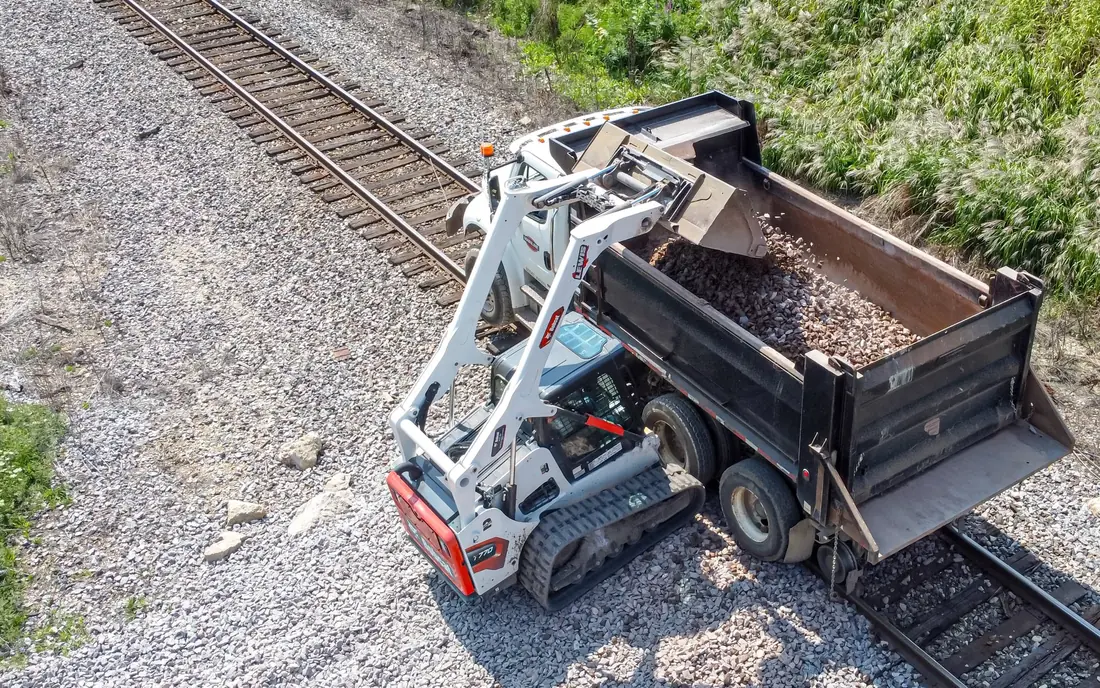

Protect the floor from bucket impact
A full bucket of rock dropped from several feet hits the floor hard. Repeated drops can:
- Dent or "oil can" the floor plate between crossmembers.
- Crack welds where the floor meets the crossmembers.
- Bend the crossmembers themselves on lighter-built trailers.
Ask the operator to lower the bucket close to the floor before dumping, especially for the first few buckets when there's no cushion of material yet. For rock, rubble, or concrete chunks, put a few buckets of fine material down first as a bed. If you load a lot of riprap or demolition debris, a thicker floor matters. See dump trailer steel gauge explained.
Spread the buckets across the bed
- Wheel loader or skid steer from the side: Have the operator place buckets front, middle, and rear, not all in the middle. The first bucket goes toward the front.
- Excavator: An excavator can place material precisely. Work from front to rear and keep the bucket low.
- From the rear with a skid steer: Be careful. It's easy to pile everything at the gate. Push material forward or load from the side.
Watch the sides and the hitch
- Keep bucket teeth and cutting edges off the top rails and sides. One hit can bend a side panel or a stake pocket.
- Leave the trailer hooked to the truck during loading. An unhitched dump trailer sitting on its jack can tip backward if the weight lands behind the axles, or push the jack into soft ground.
- Set the truck's parking brake and chock the trailer wheels on any slope.
Securing the load
Loose, flowable material mostly stays put once it settles, but it can still blow, bounce, or leak.
- Gates: Close and latch the rear gate, and pin the latch if it has a pin hole. On spreader gates, set both chains to the same length.
- Gaps: Fine material like sand or screenings can leak through gate seams. Some owners add a rubber gate seal.
- Discrete items: Pallets, equipment, logs, and stumps need tie-downs to the D-rings or stake pockets, just like on a flatbed. Shifting cargo can change the trailer's balance mid-trip.
For commercial motor vehicles, federal rules at 49 CFR 393.100 require cargo to be contained or secured so it doesn't leak, spill, blow, or fall off, and doesn't shift enough to affect stability. Whether those rules apply to your particular rig depends on weight and use. Most states have their own load-covering laws that apply to everyone. See DOT requirements for dump trailers.
Tarping
Tarp anything that can blow out: mulch, sand, dry dirt, gravel, demolition debris, leaves, brush. A rock from a dump trailer can crack a windshield behind you, and in many states that's a ticket.
- Tarp after loading and before you hit the road, not after.
- A roll tarp should lie flat and cover the load completely, with the bow or end cap secured.
- Don't heap material above the sides. The tarp won't seal and the load will catch the wind.
- Check the tarp at your first stop. The industry-standard owner's manual recommends stopping every 50 miles or one hour to check the coupler, chains, cargo, and doors.
Tarp systems range from manual crank to electric. We compare them in dump trailer tarp systems.
Quick loading checklist
- Know your payload: GVWR minus empty weight.
- Truck and trailer hooked up, on firm level ground, parking brake set.
- Tell the loader operator your payload. Ask the bucket weight.
- First buckets go low and gentle, toward the front.
- Spread the load evenly front to back and side to side, and keep it low.
- Stop at the weight limit, even if the bed isn't full.
- Close and pin the gates, tie down any discrete items, tarp.
- Look down the bed and check the truck's stance. Weigh it if unsure.
- Re-check the load and tarp at the first stop.
The bottom line
Load a dump trailer by weight, not by volume. Spread the material evenly with a slight forward bias so 10–15% of the weight sits on a bumper-pull hitch, and keep the pile low and level. Have buckets set down gently to protect the floor, stop at the payload limit, and tarp anything that could blow out.
Frequently asked questions
How much tongue weight should a dump trailer have?
For a bumper-pull dump trailer, the common target is 10–15% of the total loaded trailer weight. Dexter's axle manual says about 10%, increasing to 15% for light trailers. Gooseneck trailers usually carry around 20–25% on the hitch.
Should you load a dump trailer heavier in the front?
Load it evenly with a slight bias forward of the axles, so the tongue carries 10–15% of the weight. Don't pile everything at the front, because that overloads the truck's rear axle. Weight behind the axles can cause sway.
Can you fill a dump trailer to the top with gravel?
Usually not. Gravel weighs roughly 2,700–3,000 lb per cubic yard, so most dump trailers reach their payload limit well before the bed is full. Calculate yards from payload, not from the box size.
Do I need to tarp my dump trailer?
If the load can blow, spill, or bounce out, yes. Commercial vehicles fall under federal cargo securement rules, and many states require tarps on loose loads. Check your state's rules and tarp anyway when in doubt.
Share this guide
Link to this guide
Writing about dump trailers? You're welcome to quote this guide and link to it. Copy whichever format you need.
- URL
- https://stranktrailers.com/guides/how-to-load-a-dump-trailer
- HTML link
- <a href="https://stranktrailers.com/guides/how-to-load-a-dump-trailer">How to Load a Dump Trailer</a> (Strank Trailers)
- Citation
- Strank Trailers. "How to Load a Dump Trailer." stranktrailers.com, October 28, 2026. https://stranktrailers.com/guides/how-to-load-a-dump-trailer
Keep reading
Towing · 11 min read
What Truck Do You Need to Pull a Dump Trailer?
What truck you need to pull a dump trailer: half-ton vs. 3/4-ton vs. 1-ton, payload vs. towing capacity, hitch ratings, and real combos for 7k to 20k+ trailers.
Business · 10 min read
Material Weight Chart: Gravel, Dirt, Sand, Mulch, and More
Material weight chart in pounds and tons per cubic yard for gravel, dirt, sand, mulch, concrete, and debris, plus how many yards a dump trailer can haul.
Specs · 10 min read
GVWR, Payload, and Empty Weight Explained
GVWR is the most a loaded trailer may weigh. Payload is GVWR minus empty weight. How to read the label, find real payload, and check tongue weight and GCWR.