
Powder Coat vs. Paint vs. Galvanized
Powder coat vs. paint vs. galvanized dump trailers: how each finish is applied, why surface prep matters most, where rust starts first, and what road salt does.
By Strank Trailers9 min read
The short version
- Surface prep decides how long any finish lasts. Blasted steel with a pretreatment and primer beats a premium topcoat sprayed over mill scale.
- Powder coat is thicker and tougher than typical wet paint, but rust can creep under a chip if there's no zinc-rich primer beneath it.
- Hot-dip galvanizing protects inside and out with sacrificial zinc. It is less common on dump trailers because heat can warp thin sheet steel and it adds cost.
- Rust usually starts inside the box, where the floor meets the sides, on top of the crossmembers, and under the bed where road spray hits.
- Magnesium chloride and calcium chloride de-icers stay wet at much lower humidity than rock salt. Rinse the underside often in winter.
On this page
On a dump trailer, powder coat usually outlasts conventional wet paint, and hot-dip galvanizing usually outlasts both. That ranking only holds if the steel was prepared properly first. Surface prep matters more than the topcoat. A powder coat sprayed over mill scale will flake. A good epoxy-primed wet paint over blasted steel can last for years. Galvanizing protects best of all, but it brings its own tradeoffs on thin sheet steel.
This guide explains how each finish is applied, where dump trailers rust first, and what to look for before you buy.
Surface prep: the step you can't see
Hot-rolled steel, which is what most trailer frames and boxes are made from, leaves the mill covered in mill scale. That's a thin, bluish-black layer of iron oxide. Mill scale looks like a decent surface, but it's brittle and doesn't bond well to the steel underneath. Paint applied over it eventually lets go when the scale cracks and pops off. Water gets in behind it, and rust spreads under the coating.
Good builders remove mill scale and contamination before coating:
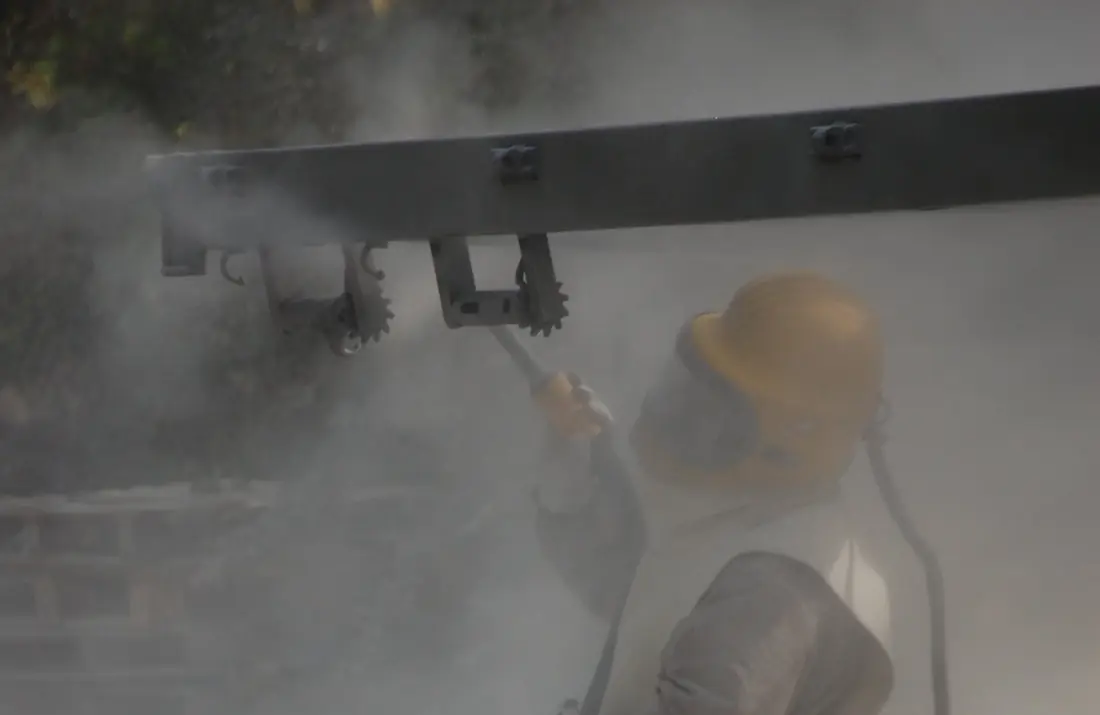
Abrasive blasting
Abrasive blasting (sandblasting or shot blasting) strips mill scale, rust, and weld spatter. It also leaves a rough surface "profile" that coatings grip. Industrial standards from SSPC (now part of AMPP) grade how clean the surface is:
| Standard | Name | What it means |
|---|---|---|
| SSPC-SP 6 | Commercial blast | Most mill scale and rust removed; some staining allowed |
| SSPC-SP 10 | Near-white blast | At least 95% of each area free of visible residue |
| SSPC-SP 5 | White metal blast | All visible mill scale, rust, and coatings removed |
Zinc-rich primer makers typically require at least SSPC-SP 10. Few trailer builders publish their blast standard, so ask.

Chemical pretreatment
After blasting, or instead of it on some lines, parts go through a wash and conversion coating. Usually that's an iron phosphate or zinc phosphate wash, or a newer zirconium-based treatment. The wash removes oil and shop dirt. The conversion coating leaves a thin crystalline layer that improves adhesion and slows rust if the topcoat is breached. Zinc phosphate generally offers better corrosion resistance than iron phosphate.
A builder that only wipes the steel with solvent before painting is skipping the most important part of the job.
Primers
A primer bonds to the prepared steel and gives the topcoat something to grip. On trailers, the main types are:
- Epoxy primer. It sticks hard to steel, resists moisture, and is a good base under either wet paint or powder.
- Zinc-rich primer (wet or powder). It is loaded with zinc dust. When the topcoat is chipped, the zinc corrodes first and protects the steel next to the chip. This is the same sacrificial idea as galvanizing, on a smaller scale.
- Etch or self-etching primer. It is common in refinishing. It's fine for repairs but weaker as a factory base for a working trailer.
The primer is where a coating system resists undercutting, the rust that creeps sideways under the paint from a chip or scratch. That creep is what turns a dime-size rock chip into a bubbled, flaking patch the size of your hand.
Wet paint vs. powder coat vs. galvanizing
Wet paint
Wet (liquid) paint is sprayed on and dries or cures in air or a low-heat booth. Common trailer systems use an enamel, polyurethane, or epoxy topcoat. Typical film is about 1–2 mils (thousandths of an inch) per coat, so durability depends on primer quality and the number of coats.
- Pros: Low equipment cost. It coats large assemblies in one piece, gets into corners well, and is easy to touch up and repaint.
- Cons: A thinner film per coat. Single-coat paint over unprepared steel is the most common cheap finish, and it fails fastest.
Powder coat
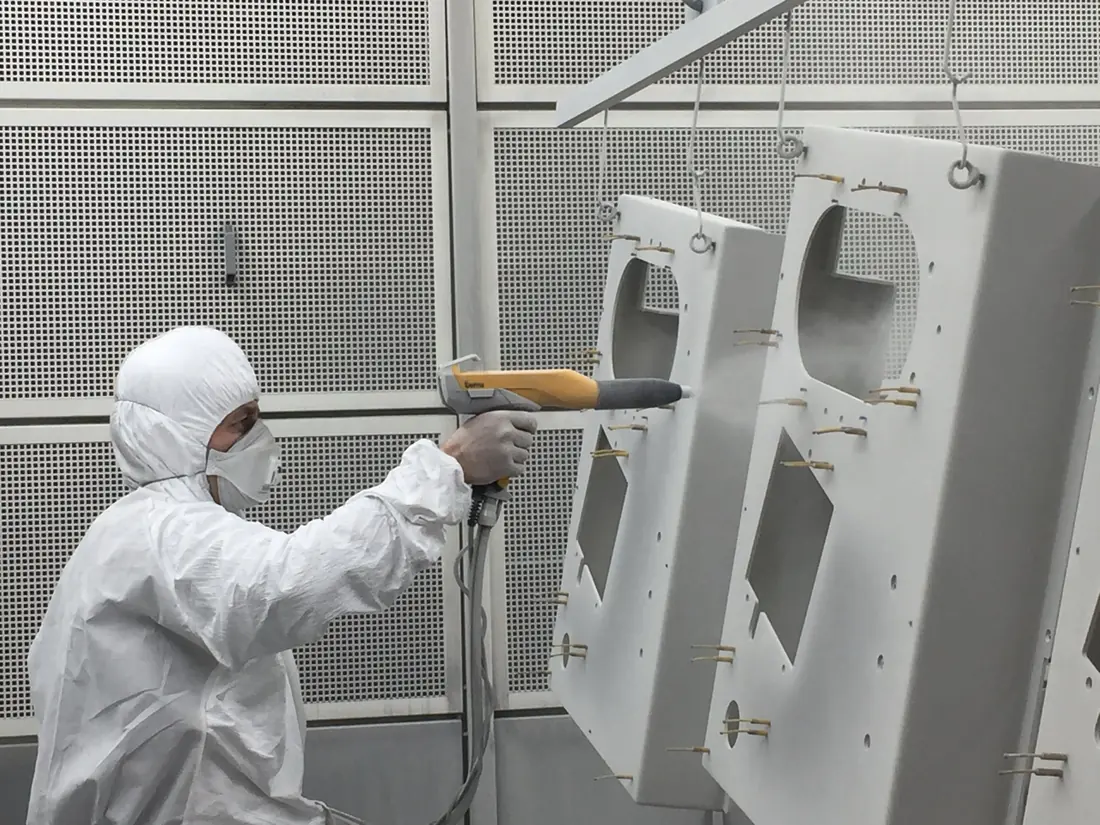
Powder coating sprays dry paint powder that is electrostatically charged so it clings to grounded steel. The part then goes through an oven, typically around 350–400°F, where the powder melts and cures into a hard film. A single coat commonly builds 2.5–6 mils.

- Pros: A thick, tough, chip-resistant film in one pass, with good color and gloss retention. Many builders now market a multi-step powder process. Diamond C, for example, describes a 6-step powder process developed with Sherwin-Williams.
- Cons: The whole part has to fit in the oven. Coverage is thinner on sharp edges and deep inside corners, and it can't reach the inside of closed tubes. When a chip goes through to bare steel, rust can creep under the film unless a zinc-rich or epoxy primer is underneath. Field touch-up won't match the factory finish.
Hot-dip galvanizing
Hot-dip galvanizing dips the fabricated steel in molten zinc at about 840°F (449°C). The zinc bonds metallurgically with the steel, forming zinc-iron alloy layers under a layer of pure zinc. ASTM A123 requires at least 3.9 mils of zinc on steel 1/4 inch or thicker. Thinner steel gets a thinner minimum coating.
- Pros: It coats every surface the zinc can reach, including the inside of vented tubes. It protects sacrificially at scratches and cut edges, and needs no touch-up for years. According to the American Galvanizers Association, the zinc-iron alloy layers are harder than the base steel, which helps with abrasion.
- Cons: Thin sheet and plate (1/4 inch and under) is most prone to warping in the kettle as heat releases stresses from rolling and welding. A dump box is mostly thin sheet. Closed sections need vent and drain holes, or trapped moisture can turn to steam and burst them. It also adds weight and cost, and the finish is a dull gray unless painted or powder coated over (a "duplex" system). Welding galvanized steel releases zinc fumes, so it should be galvanized after fabrication.
That's why galvanized dump trailers are less common than galvanized boat or utility trailers. Some builders galvanize the frame and coat the box separately to get around distortion.
Side-by-side
| Factor | Wet paint | Powder coat | Hot-dip galvanized |
|---|---|---|---|
| Typical thickness | 1–2 mils/coat | 2.5–6 mils/coat | ~2–4+ mils (by steel thickness) |
| Protection if chipped | Barrier only (unless zinc primer) | Barrier only (unless zinc primer) | Sacrificial zinc protects nearby steel |
| Inside closed tubes | No | No | Yes, if vented |
| Touch-up | Easy | Hard to match | Zinc-rich paint |
| Main weak spot | Poor prep, thin film | Creep under chips | Distortion on thin sheet, cost |
Where dump trailers rust first
The places that fail first get the most water, salt, and abrasion and the least coating:
- Inside the box floor. Rock, broken concrete, and skid steer buckets grind through any coating. Water then sits in the scratches.
- The floor-to-side seam. Dirt and water collect in the corner and stay wet. A skip-welded (stitch-welded) seam leaves gaps where water wicks in.
- Tops of crossmembers. Where the floor sheet sits on a crossmember, water gets trapped between the two pieces of steel. Neither surface can be coated after assembly, and rust swells the joint from inside. See Dump Trailer Frames: I-Beam, Channel, Tube, and Crossmembers.
- Under the bed and the front of the trailer. These take direct spray from the tow vehicle's tires, including winter brine.
- Hinges, gate pins, and hoist pivots. Moving parts wear the coating away.
- Inside tubes with no drain holes. Condensation collects inside and rusts them from within.
- Behind lights, clearance markers, and wiring clips. Drilled holes leave bare edges.
Careful welding helps here too. Continuous welds with no pinholes and no trapped slag give the coating a clean surface to seal. Gappy welds and spatter create pockets that no coating can protect.
Road salt and de-icers
Rock salt (sodium chloride) is hard on steel. Brines made with magnesium chloride and calcium chloride add a twist: they're hygroscopic, meaning they pull moisture out of the air. Corrosion engineer Bob Baboian has been quoted explaining that magnesium chloride dissolves at only about 20–30% relative humidity, while rock salt stays a dry crystal until humidity reaches about 70%. A trailer coated in magnesium chloride brine can stay wet for days in weather that would dry off rock salt. Studies disagree on which chloride is most corrosive in the lab, but the longer steel stays wet, the longer it rusts.
What helps in salt country:
- Rinse the underside often in winter, not just the visible box. Use a pressure washer or an under-chassis wand, and pay attention to crossmembers, the tongue, and the hoist area.
- Rinse out the box after hauling salt, fertilizer, or wet material. Don't let a wet load sit.
- Touch up chips before winter with a zinc-rich primer and compatible topcoat.
- Open drain holes in tubes and make sure the bed can drain.
- Store it out of standing water and, if possible, under cover. Our rust prevention and storage guide covers this in detail.
Undercoating: when it helps and when it hurts
Undercoating products fall into two groups:
- Oil, lanolin, or wax-based coatings stay soft and creep into seams, including the crossmember-to-floor joint. They need reapplying, usually yearly, and they collect dirt. They're good at slowing rust that has already started.
- Rubberized or asphalt-based coatings dry hard and quiet road noise. If they go on over rust, or crack and lift later, they trap water against the steel where you can't see it.
Undercoating supplements a good factory finish. It doesn't replace one. It works best on clean, dry, rust-free steel.
The bottom line
Choose a dump trailer by how it was prepped first and how it was coated second. Blasted steel, a phosphate or similar pretreatment, and a real primer under the topcoat matter more than the words "powder coated" on a sticker. Powder coat generally beats single-stage wet paint. Galvanizing protects best but is rarer on dump boxes because of warping, weight, and cost. Wherever you live, rinse the underside, fix chips early, and watch the floor seams and crossmembers. That's where trailers rust first and where cheap finishes give up. For the full cost picture, see Why Cheap Dump Trailers Cost More.
Frequently asked questions
Is powder coating better than paint on a dump trailer?
Usually, if both are applied over properly blasted and pretreated steel. Powder coat goes on thicker in one coat and resists chipping better than typical wet paint. A good multi-coat wet paint system with an epoxy or zinc-rich primer can outperform a powder coat applied over poorly prepared steel.
Why aren't more dump trailers galvanized?
Hot-dip galvanizing dips the finished part in molten zinc at about 840°F. Thin sheet steel like a 10-gauge floor can warp from the heat, closed tubes need vent holes, and the process adds cost and weight. Some builders galvanize the frame and coat the box separately.
Should I undercoat a new dump trailer?
It can help, especially in salt states, if applied to clean, rust-free steel. Oil- or wax-based undercoatings creep into seams but need reapplying, usually yearly. Hard rubberized undercoatings can trap moisture if they crack or go on over existing rust.
Where does a dump trailer rust first?
Usually inside the box at the floor-to-side seam, on the floor where loads abrade the coating, on top of crossmembers under the floor, at hinge points, and on the underside and front where tow-vehicle spray hits.
Share this guide
Link to this guide
Writing about dump trailers? You're welcome to quote this guide and link to it. Copy whichever format you need.
- URL
- https://stranktrailers.com/guides/powder-coat-vs-paint-dump-trailer
- HTML link
- <a href="https://stranktrailers.com/guides/powder-coat-vs-paint-dump-trailer">Powder Coat vs. Paint vs. Galvanized</a> (Strank Trailers)
- Citation
- Strank Trailers. "Powder Coat vs. Paint vs. Galvanized." stranktrailers.com, October 28, 2026. https://stranktrailers.com/guides/powder-coat-vs-paint-dump-trailer
Keep reading
Specs · 11 min read
Dump Trailer Frames: I-Beam, Channel, Tube, and Crossmembers
How dump trailer frames are built: I-beam vs. channel vs. tube rails, beam size and weight per foot, crossmember spacing, tongue design, and rear hinges.
Specs · 15 min read
How to Judge Weld Quality on a Trailer
How to judge weld quality on a trailer: spot undercut, porosity, cold lap, and cracks, find the welds that matter most, and know what to ask the builder.
Ownership · 9 min read
Dump Trailer Rust Prevention and Storage
Dump trailer rust prevention and storage: where rust starts, washing off salt and magnesium chloride, touch-up, coatings, and how to store a trailer for winter.