
Dump Trailer Frames: I-Beam, Channel, Tube, and Crossmembers
How dump trailer frames are built: I-beam vs. channel vs. tube rails, beam size and weight per foot, crossmember spacing, tongue design, and rear hinges.
By Strank Trailers11 min read
The short version
- Most 14,000 lb GVWR dump trailers ride on 8 in I-beam main rails with 3 in channel crossmembers on 16 in centers.
- Ask for weight per foot, not just depth. An "8 in I-beam" can weigh anywhere from 10 to 15 lb/ft, and the heavier beam is about 50% stiffer.
- Depth drives bending strength. A standard 8 in, 10 lb I-beam is about 2.3 times stiffer than a 6 in channel and weighs only 1.8 lb/ft more.
- Moving crossmembers from 16 in to 12 in centers cuts floor sag between them by roughly two-thirds.
- The tongue-to-frame junction, rear hinge, and hoist mounts carry the most concentrated loads, and that's where weak frames crack first.
On this page
- The parts of a dump trailer frame
- Main rail types: channel, I-beam, and tube
- Why an I-beam resists bending: section properties in plain English
- Typical frame specs by trailer class
- Crossmember spacing: 12 vs. 16 vs. 24 inch centers
- Tongue construction
- Rear hinge design
- Bed frame vs. main frame: why both matter
- The bottom line
A dump trailer frame is two main rails (I-beam, channel, or rectangular tube) tied together by crossmembers, with a tongue up front and a separate bed frame that pivots on a rear hinge. On a typical 14,000 lb GVWR bumper-pull, that means 8 in I-beam rails weighing 10 to 15 lb per foot, with 3 in channel crossmembers on 16 in centers.
Those numbers matter more than the brochure lets on. The beam's depth and weight per foot, how close the crossmembers are, and how the tongue and hinge are built decide whether a trailer stays straight for 20 years or starts cracking in three.
The parts of a dump trailer frame
A dump trailer has two frames stacked on top of each other.
- The main frame (chassis): the two main rails, the crossmembers between them, the tongue, and the spring hangers that hold the axles. It carries everything down the road.
- The bed frame (subframe): the dump body's own frame, made of long sills under the floor plus bed crossmembers. It sits on the main frame when lowered and pivots on the rear hinge when you dump.
- The rear hinge connects the two at the back.
- The hoist sits between them and does the lifting.
Load Trail's DT14 spec sheet is a good example because it lists both frames separately: 8 in I-beam main frame and tongue, 5 in channel main-frame crossmembers, a 2 x 6 in tube bed frame, and 3 in channel bed crossmembers. Not every builder breaks it out that clearly, so if you only see one frame spec, ask about the other.
Main rail types: channel, I-beam, and tube
C-channel
Channel is shaped like a squared-off "C": a vertical web with flanges sticking out on one side. It's inexpensive, easy to weld, and easy to bolt to. Because it isn't symmetrical, it tends to twist under load. You'll find channel main rails mostly on lighter trailers, and in tongues on some heavier ones. Texas Pride, for example, uses an 8 in, 11.5 lb channel tongue that it describes as fully wrapped.
I-beam
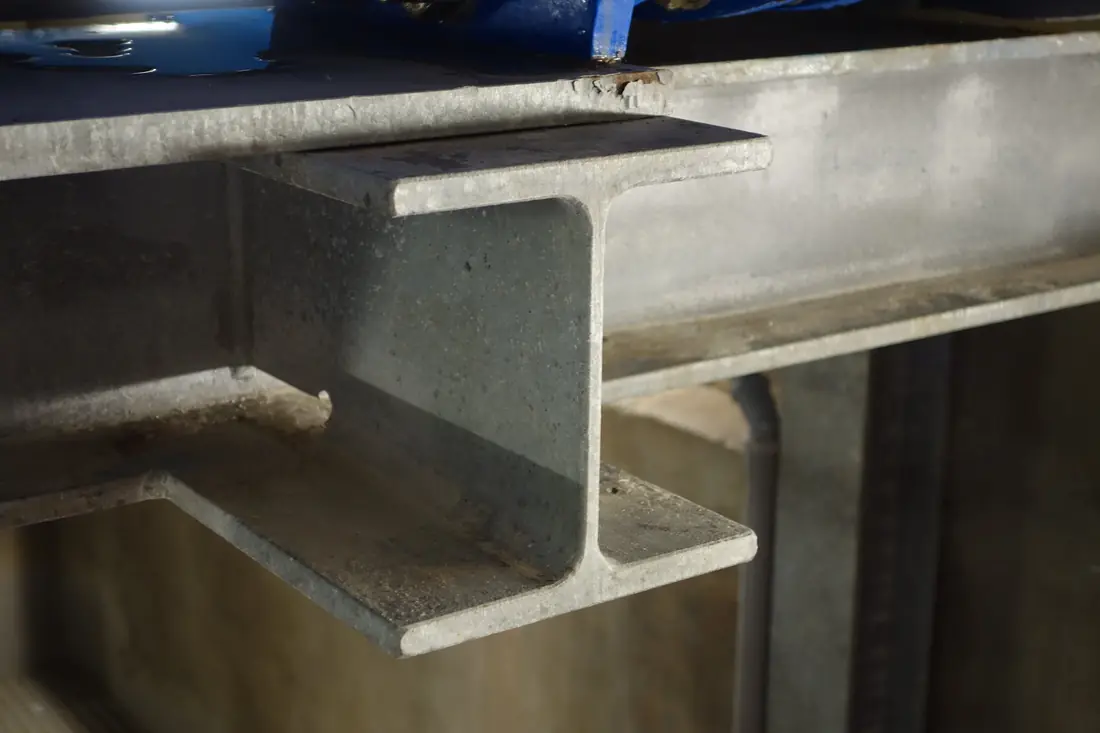
An I-beam has a tall vertical web with a flange on the top and bottom. Most trailer "I-beams" are wide-flange shapes, or close relatives of them. It's the most common main rail on 14k and heavier dump trailers because it puts a lot of steel where it does the most good against up-and-down bending.
Rectangular tube
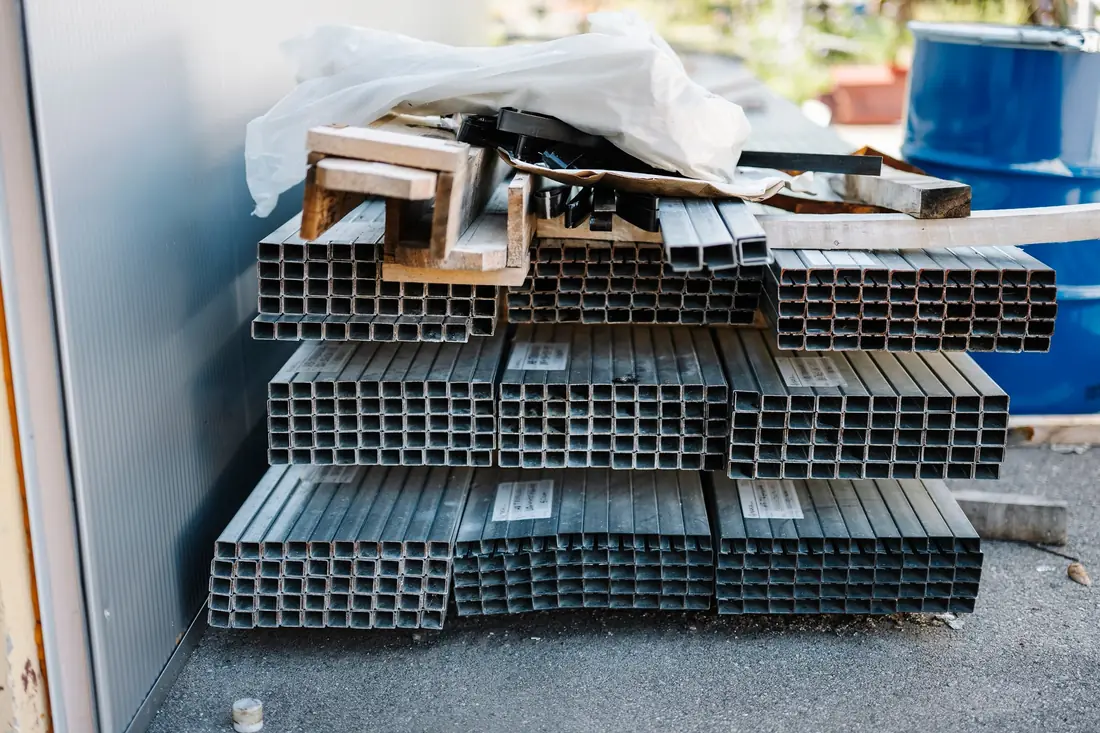
Tube is a closed box section, such as 6 x 2 in. It resists twisting far better than open shapes, and it looks clean. Big Tex's light-duty 90SR uses "6x2 rectangular tubing ILO [in lieu of] 6 in channel," and Texas Pride builds its 16K dump on 6 x 2 in heavy-wall rectangular tubing. The catch is that tube can rust from the inside out where you can't see it, unless the ends are sealed or the tube is built to drain.

Formed and engineered beams
Some builders use their own beam designs. PJ lists an "8 in x 10 lb formed I-beam," Diamond C offers an "engineered beam frame" option, and Big Tex specifies a "seamless" I-beam. These can be perfectly good. Just ask how the beam is made and what its weight per foot is, so you can compare it to a standard rolled beam.
Why an I-beam resists bending: section properties in plain English
Engineers use two numbers to compare beams:
- Moment of inertia (Ix) measures stiffness, or how much the beam sags under a load. Higher is stiffer.
- Section modulus (Sx) measures bending strength, or how much load the beam can take before the steel starts to permanently bend. Higher is stronger.
Both depend mostly on how far the steel sits from the beam's center. Steel in the top and bottom flanges does most of the work, and the web just holds them apart. That's why an I-beam beats a channel of similar weight, and why depth matters so much: stiffness grows roughly with the square of depth for the same flanges.

Here's how common trailer rail sizes compare, using standard AISC shapes as close equivalents. Builders' beams may differ slightly.
| Shape | Weight (lb/ft) | Depth (in) | Stiffness, Ix (in⁴) | Strength, Sx (in³) |
|---|---|---|---|---|
| C6x8.2 channel | 8.2 | 6.0 | 13.1 | 4.35 |
| 6 x 2 x 3/16 in tube | about 9.4 | 6.0 | 10.5 | 3.49 |
| W8x10 I-beam | 10 | 7.89 | 30.8 | 7.81 |
| W8x13 I-beam | 13 | 7.99 | 39.6 | 9.91 |
| W8x15 I-beam | 15 | 8.11 | 48.0 | 11.8 |
| W10x12 I-beam | 12 | 9.87 | 53.8 | 10.9 |
What that table tells you:
- An 8 in, 10 lb I-beam weighs 22% more than a 6 in channel but is about 2.3 times stiffer and 1.8 times stronger.
- A 10 in, 12 lb I-beam is about 75% stiffer than an 8 in, 10 lb beam for just 2 lb/ft more steel. Depth is the cheapest way to buy stiffness.
- Among 8 in beams, going from 10 to 15 lb/ft makes the beam about 56% stiffer and 51% stronger.
Ask for weight per foot
"8 in I-beam" on a spec sheet doesn't tell you much by itself. Big Tex's 14LP and PJ's DL both list an 8 in, 10 lb beam. Diamond C's LPT lists an 8 in, 15 lb beam. All three are "8 in I-beam" trailers, but if the beams follow standard proportions, the 15 lb beam is about 50% stiffer. If a builder won't tell you the weight per foot, that's worth noting.
Where tubes win: twisting
Open shapes like channel and I-beam resist bending well but twist easily. A closed tube is very different. The torsional constant (a measure of twisting stiffness) of a W8x10 I-beam is about 0.043 in⁴. For a 6 x 2 x 3/16 in tube it's about 5.2 in⁴, more than 100 times higher.
That's why tube-frame trailers can feel rigid even with shallower rails. It's also why I-beam and channel frames depend heavily on their crossmembers and welds to keep the frame from racking. If one wheel drops into a hole or you dump on uneven ground, the crossmembers keep the rails working together.
Typical frame specs by trailer class
| Class | Typical main rails | Typical crossmembers | Examples |
|---|---|---|---|
| Light duty (7k–10k GVWR) | 6 in channel, 6 x 2 in tube, or 6 in I-beam | 3 in channel, 16 in centers | Big Tex 90SR, Load Trail DT10 |
| 14k bumper pull | 8 in I-beam, 10–15 lb/ft | 3 in channel or I-beam, 16 in centers | Big Tex 14LP, PJ DL, Load Trail DT14, Diamond C LPT |
| 16k–20k bumper pull | 8 in or 10 in I-beam, or heavy-wall tube | 3 in channel, 16 in centers (12 in optional on some) | Big Tex 16LP, Big Tex 20LP, Texas Pride 16K |
Specs are from manufacturer websites as of October 2026. Builders revise frames by model year, so check the current spec sheet. Goosenecks and deckovers have their own frame layouts. See low-profile vs. deckover dump trailers and gooseneck vs. bumper pull for how those change things.
Crossmember spacing: 12 vs. 16 vs. 24 inch centers
Crossmember spacing is listed as inches "on center" (OC), meaning the distance from the center of one crossmember to the center of the next.
- 16 in OC is the norm for 14k dump trailers. Big Tex, PJ, and Diamond C all list 3 in crossmembers on 16 in centers as standard.
- 12 in OC is the common heavy-duty upgrade. PJ and Diamond C both list 12 in centers as options.
- 24 in OC shows up on some light utility trailers. Under a dump bed carrying rock, it leaves too much floor unsupported.
Why spacing matters so much
The floor between two crossmembers acts like a short beam. For an evenly spread load, the sag grows with roughly the fourth power of the span. For a concentrated load, like a skid-steer track or a dropped boulder, it grows with roughly the cube.
| Change | Floor sag, even load | Floor sag, point load |
|---|---|---|
| 24 in → 16 in centers | about 20% of original | about 30% of original |
| 16 in → 12 in centers | about 32% of original | about 42% of original |
Going from 16 to 12 in centers does about as much for the floor as stepping up a gauge. Read our guide to dump trailer steel gauge alongside this one, because floor thickness and crossmember spacing work as a pair.
On a 14 ft bed, 12 in centers add three or four crossmembers. With 3 in channel at about 4 lb/ft across a 7 ft bed, that's on the order of 100 lb.
Crossmember types
- Channel is the most common. It's light and easy to weld, but the open side can trap dirt and moisture.
- I-beam crossmembers, like Diamond C's 3 in I-beams, are symmetrical and a bit stiffer for the weight.
- Tube crossmembers are stiff and resist twisting, but they can rust inside if they aren't sealed.
- Formed sections made by press-braking sheet into a hat or channel shape are lighter, and their quality depends on thickness and design.
How crossmembers attach matters as much as their shape. A crossmember welded on all sides where it meets the rail is far stronger than one tacked with short stitches. See how to judge weld quality on a trailer for what good joints look like.
Tongue construction
The tongue carries the trailer's tongue weight, all the pulling and braking forces, and every jolt from the hitch. The highest bending load in the whole frame happens where the tongue meets the main frame.
Builders handle this two ways:
- Integrated (straight-through) tongue. The main rails continue forward and angle in to meet the coupler, so there's no splice at the front of the box. Big Tex specifies an "8 in seamless I-beam integrated w/ frame" tongue on the 14LP and 16LP.
- A-frame tongue. Separate members are welded to the front of the main frame and meet at the coupler. This can be just as strong if the joint is well designed, with full welds and gussets that spread the load.
Heavier trailers usually use a heavier tongue than main rail. Big Tex's 20LP pairs a 10 in main frame with a 12 in, 14 lb I-beam tongue. PJ's DL uses an 8 in x 10 lb formed I-beam tongue to match its main frame.
Rear hinge design
The rear hinge carries the whole loaded bed during a dump. At the start of the lift, the hinge and hoist share the load. As the bed tips, more and more of it moves onto the hinge.
What separates a good hinge from a weak one:
- Pin size. Aftermarket dump hinges range from about 1 in pins on light-duty hinges to 1-1/2 in and 2 in pins on hinges rated for 24 and 30 tons. Bigger pins resist bending and wear longer.
- Grease fittings. A greasable pin or bushing lasts much longer than a dry pin rusting in place. Ask how often it should be greased.
- Spacing. Hinges set near the outside of the frame give the raised bed a wider base and resist side-to-side rocking.
- Mounting. Hinge plates should be fully welded to both the main frame and the bed frame, with enough plate around the pin that the load spreads out instead of tearing at one weld.
Hinge position also affects stability. When you raise a loaded bed, the load's center of gravity moves up and back. On a bumper-pull, that can lighten the tongue. Some builders, including PJ, include rear stabilizer stands to support the back of the trailer while dumping.
Bed frame vs. main frame: why both matter
When the bed is down, it rests on the main frame and the two share the load. When the bed is up, it's held at only two points: the hinge at the back and the hoist in the middle or front. Everything in between has to be carried by the bed frame alone.
A weak bed frame twists when you dump an uneven load, which strains the hinge, hoist mounts, and floor welds. That's why a builder who uses heavy main rails but a light bed frame hasn't really built a heavy-duty trailer. Look for full-length sills under the bed, like Load Trail's 2 x 6 in tube bed frame on the DT14, and crossmember spacing under the floor that matches the work you do.
Also check how the bed sits on the main frame when lowered. It should rest evenly along its length. Gaps mean the bed pounds on the frame over every bump, which wears both parts.
How the hoist attaches to both frames matters too. See scissor hoist vs. telescopic vs. dual-ram for how each design loads the frame.
The bottom line
For a 14k dump trailer, 8 in I-beam rails on 16 in crossmembers are the baseline. A heavier beam (13–15 lb/ft), a 10 in beam, or 12 in crossmember centers are real upgrades you can verify on a spec sheet. Ask for weight per foot, look hard at the tongue junction, hinge, and hoist mounts, and remember the bed frame has to be stiff too, because it carries the whole load every time you dump.
Frequently asked questions
Is an I-beam or tube frame better for a dump trailer?
Each has strengths. An I-beam puts more steel where it resists up-and-down bending, which is the main load on a trailer. A rectangular tube resists twisting far better and is common on lighter trailers, but it can rust from the inside if it isn't sealed or drained.
What size I-beam does a dump trailer need?
Most 14,000 lb bumper-pull dump trailers use an 8 in I-beam, and many 20,000 lb models step up to a 10 in I-beam. Compare weight per foot too, because two 8 in beams can differ by 50% in stiffness.
What is good crossmember spacing on a dump trailer?
16 in on center is the industry norm for 14k dump trailers. 12 in centers are a common upgrade for skid-steer loading and rock, and 24 in centers are too wide for a dump floor under heavy loads.
What is the difference between the main frame and the bed frame?
The main frame is the chassis: rails, crossmembers, tongue, and axle hangers. The bed frame is the dump body's own frame, which sits on the main frame, pivots at the rear hinge, and has to stay rigid when the hoist lifts it.
Where do dump trailer frames usually crack?
Most often at the tongue-to-frame junction, around the hoist mounts, at the rear hinge mounts, and at crossmember-to-rail welds. Cracked or rust-streaked paint in those areas is the first thing to look for.
Share this guide
Link to this guide
Writing about dump trailers? You're welcome to quote this guide and link to it. Copy whichever format you need.
- URL
- https://stranktrailers.com/guides/dump-trailer-frame-construction
- HTML link
- <a href="https://stranktrailers.com/guides/dump-trailer-frame-construction">Dump Trailer Frames: I-Beam, Channel, Tube, and Crossmembers</a> (Strank Trailers)
- Citation
- Strank Trailers. "Dump Trailer Frames: I-Beam, Channel, Tube, and Crossmembers." stranktrailers.com, October 28, 2026. https://stranktrailers.com/guides/dump-trailer-frame-construction
Keep reading
Buying · 7 min read
Low-Profile vs. Deckover Dump Trailers
Low-profile vs. deckover dump trailers compared: deck height, 83 vs. 96-inch width, ramp angles, stability, fold-down sides, and which design fits your work.
Buying · 9 min read
Gooseneck vs. Bumper Pull Dump Trailers
Gooseneck vs. bumper pull dump trailers compared: capacity, tongue weight, stability, truck requirements, cost, and which hitch fits your hauling.
Specs · 10 min read
Dump Trailer Steel Gauge Explained
Dump trailer steel gauge explained: 14, 12, 10, and 7 gauge in inches and pounds, what builders use for floors and sides, and why floor gauge matters most.