
Dump Trailer Axles and Suspension
Dump trailer axles and suspension explained: 5.2k to 12k axle ratings, tandem vs. triple, slipper springs vs. torsion, hubs, and axle capacity vs. GVWR.
By Strank Trailers10 min read
The short version
- Most 14,000 lb GVWR dump trailers ride on two 7,000 lb axles. Common axle ratings step up from 5,200 to 7,000, 8,000, 10,000, and 12,000 lb.
- A trailer's GVWR can be higher than its combined axle ratings, because part of the load rides on your hitch as tongue weight.
- Slipper leaf springs with an equalizer are the most common dump trailer suspension. Torsion axles need less maintenance but can't be rebuilt when the rubber wears out.
- Easy-lube grease fittings don't replace bearing service. Dexter calls for bearing inspection every 12 months or 12,000 miles.
- Axles, springs, tires, and frame all have to carry the load. The lowest rating among them is your real limit.
On this page
Most dump trailers ride on two 7,000 lb axles with leaf-spring suspension, for a 14,000 lb GVWR. Common axle ratings step up in fixed sizes: 5,200, 7,000, 8,000, 10,000, and 12,000 lb. Your trailer's real capacity is set by the GVWR on its label, which depends on the axles, springs, tires, and frame together.
Axles and suspension get less attention than steel gauge or hoists, but they carry every pound you haul. Here's how to read the specs, what the options mean, and what overloading actually does.
Common dump trailer axle ratings
| Axle rating | Tandem total | Typical GVWR | Example trailers |
|---|---|---|---|
| 5,200 lb | 10,400 lb | 9,990 lb | Big Tex 90SR, Load Trail DT10 |
| 7,000 lb | 14,000 lb | 14,000–15,500 lb | Big Tex 14LP, PJ DL, Load Trail DT14, Diamond C LPT |
| 8,000 lb | 16,000 lb | 16,000–17,500 lb | Big Tex 16LP, Texas Pride 7x14 16K |
| 10,000 lb | 20,000 lb | 20,000 lb and up | Big Tex 20LP |
| 12,000 lb | 24,000 lb | 24,000 lb and up | Heavy goosenecks |
Specs are from manufacturer websites as of October 2026. Diamond C, for example, offers its LPT with 2 x 7k, 2 x 8k, 2 x 10k, or 3 x 7k axle packages, so one model can span several rows.
Why so many trailers are rated at 9,990 lb
You'll see 9,990 lb GVWR on a lot of smaller dump trailers. Federal motor carrier rules use 10,001 lb as one of the thresholds for a commercial motor vehicle, so staying just under it can matter for business use. The rules depend on how you use the trailer and on your truck, so read DOT requirements for dump trailers and CDL requirements before you buy based on that number.
Axle capacity vs. GVWR: why they're different numbers
Every trailer has a federal certification label. Under 49 CFR 567.4, it must list the GVWR (gross vehicle weight rating, the most the loaded trailer may weigh) and the GAWR (gross axle weight rating) for each axle.
Those numbers don't have to add up exactly, because a bumper-pull or gooseneck trailer doesn't put all its weight on its own axles. Part of it rides on your hitch as tongue weight.
- Big Tex's 16LP has two 8,000 lb axles (16,000 lb total) and a 17,500 lb GVWR. At full GVWR, at least 1,500 lb, about 9% of the total, has to ride on the hitch.
- Diamond C's standard LPT has two 7,000 lb axles (14,000 lb) and a 15,500 lb GVWR, which works the same way.
- A 14,000 lb trailer on two 7,000 lb axles with 10–15% tongue weight puts only about 11,900 to 12,600 lb on its axles at full GVWR. That leaves some margin.
Neither approach is wrong. But it means loading matters. Pile the load behind the axles and you shift weight off the hitch and onto the axles, which can overload them even when the trailer is under GVWR. Our guide on how to load a dump trailer covers tongue weight.
The tires are a limit too
Tires have their own load ratings, and they have to carry the axle load. PJ's DL, for example, ships with ST235/80R16 10-ply tires rated at 3,520 lb each. Four of them carry 14,080 lb, just above the trailer's 14,000 lb GVWR. For commercial vehicles, federal rules (49 CFR 393.75) prohibit running tires above the load marked on the sidewall. See dump trailer tires for load ranges.
The full chain includes the frame, coupler, jack, springs, hangers, axles, wheels, and tires. The lowest-rated part sets the real limit, and the manufacturer's GVWR is supposed to reflect all of them. For more on how GVWR, empty weight, and payload fit together, read GVWR, payload, and empty weight explained.
Tandem vs. triple axles
Tandem (two axles) is the standard setup for dump trailers from about 7,000 to 20,000 lb GVWR and beyond. Two axles share the load, keep the trailer stable if one tire fails, and keep tire scrub in tight turns manageable.
Triple (three axles) carries more weight within the same axle size, like 3 x 7,000 lb instead of stepping up to 10,000 lb axles. The load spreads across six tires instead of four. The trade-offs:
- More tires, brakes, and bearings to buy and maintain.
- More tire scrub in tight turns, because three axles can't all follow the same arc. Expect faster tire wear if you make a lot of tight turns on job sites.
- A longer suspension that needs equalizers between all three axles to share load evenly.
Single-axle dump trailers exist, but they're limited to light loads and are rare in the heavy-duty market.
Leaf spring vs. torsion suspension
Leaf springs: double-eye vs. slipper
A leaf spring is a stack of curved steel strips (leaves) clamped together and U-bolted to the axle. More leaves mean more capacity. PJ and Texas Pride both list 6-leaf springs on their dump trailers.
There are two main types:
- Double-eye springs have a rolled eye at each end. One eye bolts to a fixed hanger, and the other connects through a shackle or equalizer so the spring can lengthen as it flexes. They're common on lighter trailers.
- Slipper springs have an eye at the front only. The rear end is flat or curled and slides against a wear surface inside the rear hanger or equalizer. With no rear eye or shackle to wear, they handle heavy loads well. The PJ DL, Big Tex 14LP and 16LP, and Texas Pride 16K all use slipper springs, and Diamond C lists a slipper roller suspension on the LPT.
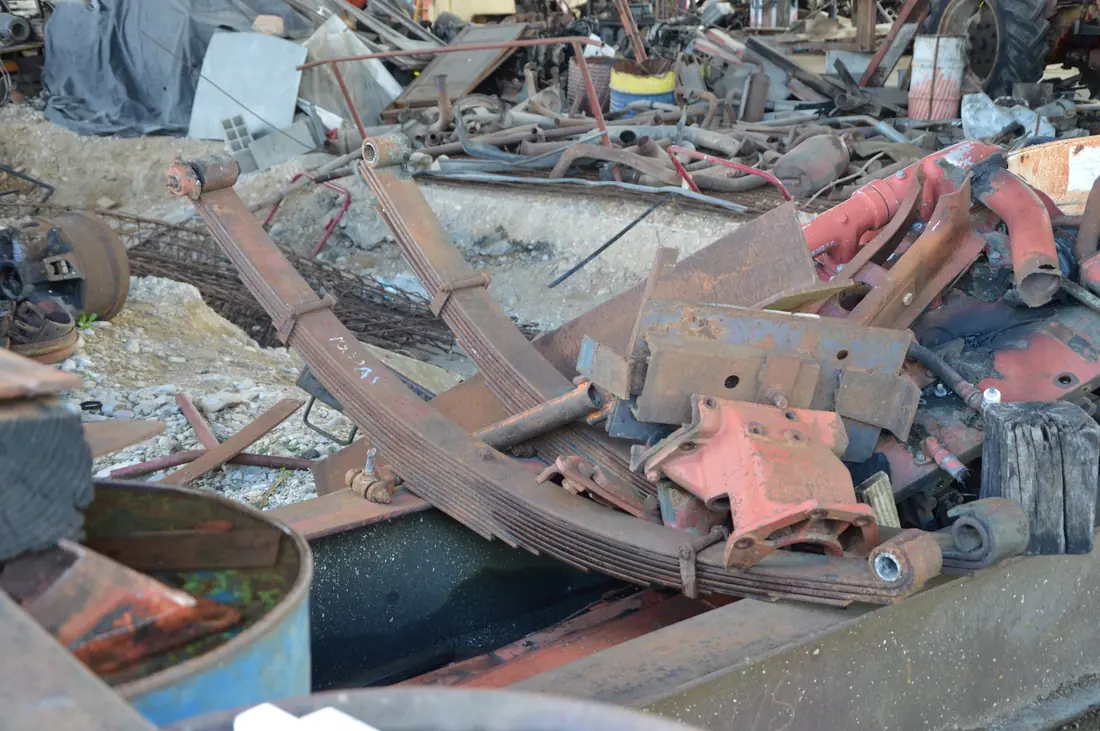

Dexter offers double-eye and slipper springs rated from 2,000 to 25,000 lb per axle.
Equalizers
On a tandem or triple, an equalizer is a rocker mounted to the center hanger between the springs. When one axle hits a bump, the equalizer pivots and passes some of the load to the other axle, so neither axle takes the hit alone. It also keeps the load shared when the trailer sits on uneven ground.
Equalizers pivot on a bolt and bushing that wear over time. Greasable bolts or long-life bushings are worth asking about. Dexter's E-Z Flex equalizer uses a rubber core to absorb road shock.
Torsion axles
A torsion axle has no leaf springs. Inside the square axle tube, a steel bar is surrounded by rubber cords. Each wheel sits on a short arm, and when the wheel moves up, the bar rotates and squeezes the rubber. Dexter's Torflex is the best-known example, and Dexter makes medium-duty Torflex axles rated from 9,000 to 12,000 lb. Big Tex's 20LP uses torsion axles on its 10,000 lb axles.
| Slipper leaf spring | Torsion | |
|---|---|---|
| Ride | Firmer, especially empty | Smoother; each wheel moves independently |
| Wear parts | Springs, hangers, equalizer, bushings, bolts | Few; nothing to grease in the suspension |
| Repair | Replace individual springs, bushings, hangers | Replace the whole axle when the rubber wears out |
| Ride height | Adjustable by changing springs or hangers | Set by the axle's arm angle |
| Common use on dump trailers | Most models | Some heavy-duty and premium models |
Neither is automatically better. Leaf springs are cheaper to repair a piece at a time. Torsion axles save maintenance and ride smoothly, which is easier on the trailer, but you can't rebuild them.
Hubs, bearings, and lubrication options
Each wheel rides on a pair of tapered roller bearings inside the hub. How those bearings are lubricated is one of the bigger maintenance differences between trailers.


| Option | How it works | What it needs |
|---|---|---|
| Standard grease | Bearings packed with grease, dust cap on the end | Remove, clean, inspect, and repack on schedule |
| E-Z Lube / "quick-lube" | Grease fitting in the spindle end pushes grease through to the inner bearing | Still needs periodic inspection; don't over-grease |
| Oil bath | Hub filled with oil behind a clear cap so you can see the level | Check the oil level and look for leaks regularly |
| Sealed (Dexter Nev-R-Lube) | Sealed cartridge bearings | Designed not to need regular greasing; check Dexter's current terms |
A few things worth knowing:
- Easy-lube isn't no-lube. Dexter's manual says the convenient lubrication provisions "must not replace periodic inspection of the bearings," and calls for bearing inspection every 12 months or 12,000 miles. Pumping in too much grease can push it past the rear seal and onto the brake shoes.
- Oil bath is common on heavier axles. Big Tex specifies oil bath hubs with Valcrum caps on its 8,000 lb and 10,000 lb axles. You can check the oil at a glance, but a leaking seal can run a bearing dry, so look every time you hook up.
- Dexter's E-Z Lube is offered on 5,200 to 7,000 lb axles. Nev-R-Lube is offered on Torflex and sprung axles from 5,200 to 8,000 lb.
Wheel nuts are part of the hub too. Dexter specifies 90 to 120 ft-lb for 1/2 in studs on 14 to 16 in wheels, and recommends re-torquing at 10, 25, and 50 miles after a wheel is mounted. Check your axle and wheel maker's spec for your exact setup.
Straight vs. drop spindles, and camber
- Drop spindles set the hub above the centerline of the axle tube, which lowers the trailer. Dexter offers both straight and drop spindles on most axles up to 8,000 lb. Above 9,000 lb, straight spindles are standard.
- Cambered axles are built with a slight upward bow, so they flatten out under load and keep the tires square to the road. Big Tex calls out cambered axles on its dump trailers.
Brakes
Most dump trailer axles use electric drum brakes on every axle. Self-adjusting brakes, like Dexter's Nev-R-Adjust that Load Trail lists, keep the shoes adjusted as they wear. See dump trailer brakes for electric vs. electric-over-hydraulic and breakaway requirements.
Axle brands: Dexter, Lippert, and others
You'll see a few names on most U.S. dump trailers.
- Dexter makes a wide line of trailer axles, including Torflex torsion axles and E-Z Lube, Nev-R-Lube, and oil bath hub options. Load Trail lists Dexter axles on its DT series.
- Lippert makes spring and torsion axles for utility, dump, and equipment trailers. Its axle guide lists common capacities from 2,000 to 10,000 lb. Diamond C lists Lippert 7,000 lb axles as standard on the LPT.
- Other builders use other suppliers, or don't name the brand at all.
All of the major brands make good axles. What matters more is that the axle is rated correctly for the trailer, installed straight, and backed by a supplier with parts available near you. If the spec sheet doesn't name the axle brand, ask. The brand and part number are usually on a tag or sticker on the axle tube.
What overloading actually does
Running over GVWR or GAWR doesn't usually cause a dramatic failure on the first trip. It wears the trailer out faster and stacks up risks:
- Bent axles. An overloaded axle can lose its camber, which tilts the tires and wears their inside edges.
- Flattened or broken springs, and hangers that crack or tear away from the frame.
- Hot bearings and tires. Overloaded ST tires build heat quickly at highway speed, which is a common cause of blowouts.
- Longer stopping distances and brakes that fade on long grades.
- Legal and insurance exposure if you're stopped overweight or involved in a crash.
The bottom line
Two 7,000 lb axles on slipper springs with an equalizer is the standard setup for a 14k dump trailer. Heavier trailers step up to 8,000 and 10,000 lb axles, sometimes on torsion. Read the GVWR and GAWR on the label, make sure the tires cover the load, and keep up with bearing service, whatever hub style you choose. Overloading doesn't always break something right away, but it shortens the trailer's life and adds risk on every trip.
Frequently asked questions
What size axles does a 14,000 lb dump trailer have?
Almost always two 7,000 lb axles, which is why 14,000 lb is such a common GVWR. Some builders rate a trailer above 14,000 lb on the same axles by counting the tongue weight carried by the truck.
Are torsion axles or leaf springs better for a dump trailer?
Leaf springs, especially slipper springs with an equalizer, are the most common choice and can be repaired piece by piece. Torsion axles ride more smoothly and have fewer wear parts, but when the internal rubber wears out, you replace the whole axle.
What is the difference between slipper springs and double-eye springs?
A double-eye spring has a rolled eye at both ends, bolted to hangers or shackles. A slipper spring has an eye at the front only, and the rear end slides against a wear surface in the hanger. Slipper springs are common on 7,000 lb and heavier dump trailer axles.
Do I still need to repack E-Z Lube bearings?
Yes. Dexter states the convenient lubrication provisions must not replace periodic inspection, and calls for bearings to be inspected every 12 months or 12,000 miles. Over-greasing through the fitting can also push grease past the seal onto the brakes.
Can I put bigger axles under my dump trailer to haul more?
Not on their own. The GVWR on the manufacturer's label is the limit, and it's based on the frame, coupler, tires, and other components too. Changing it means formally recertifying the trailer, which isn't something an axle swap accomplishes.
Share this guide
Link to this guide
Writing about dump trailers? You're welcome to quote this guide and link to it. Copy whichever format you need.
- URL
- https://stranktrailers.com/guides/dump-trailer-axles-and-suspension
- HTML link
- <a href="https://stranktrailers.com/guides/dump-trailer-axles-and-suspension">Dump Trailer Axles and Suspension</a> (Strank Trailers)
- Citation
- Strank Trailers. "Dump Trailer Axles and Suspension." stranktrailers.com, October 28, 2026. https://stranktrailers.com/guides/dump-trailer-axles-and-suspension
Keep reading
Towing · 11 min read
DOT Numbers, Inspections, and Registration for Dump Trailers
Dump trailer DOT requirements explained: when you need a USDOT number, medical card, annual inspection, IFTA/IRP, and how trailer titles and plates work.
Towing · 9 min read
Do You Need a CDL to Pull a Dump Trailer?
When a dump trailer requires a CDL: the federal 26,001 lb / 10,000 lb Class A rule, how GCWR is calculated, worked truck-and-trailer examples, and state rules.
Ownership · 9 min read
How to Load a Dump Trailer
How to load a dump trailer safely: tongue weight targets, front-to-back placement, loading with a skid steer or excavator, material weights, GVWR, and tarping.