
Dump Trailer Tires: Load Range, Ply, and ST vs. LT
Dump trailer tires explained: load ranges C to H, ply ratings, ST vs. LT, 16-inch vs. 17.5-inch wheels, inflation, DOT date codes, and signs of overload.
By Strank Trailers10 min read
The short version
- Load range letters map to ply ratings: C = 6, D = 8, E = 10, F = 12, G = 14, H = 16. Higher letters carry more at higher pressure.
- The tires on each axle must together be rated at least as high as that axle's GAWR. A 7,000-lb axle needs two tires rated 3,500 lb or more.
- ST tire load ratings assume 65 mph or less unless the tire carries a speed symbol and the maker says otherwise.
- 17.5-inch wheels with Load Range H tires carry roughly 4,800 lb each and are common on 14,000 to 17,500 lb GVWR dump trailers.
- Replace trailer tires by age as well as tread. Goodyear recommends replacing tires six years after manufacture, read from the DOT date code.
On this page
- What load range and ply rating mean
- The rule: tires must cover each axle's GAWR
- ST vs. LT tires: what's the difference?
- ST tire speed ratings and the 65 mph rule
- 16-inch vs. 17.5-inch wheels
- Inflation: the biggest factor you control
- Tire age and the DOT date code
- Signs a tire is overloaded or failing
- The spare tire
- The bottom line
Most 14,000-lb dump trailers ride on ST235/80R16 tires in Load Range E or G, or on 17.5-inch commercial tires in Load Range H. The rule that matters: the tires on each axle must together be rated at least as high as that axle's GAWR, and they need to be inflated to the pressure that rating depends on. Load range, ply rating, and ST vs. LT all come back to that one question: can these tires carry this axle's weight?
Dump trailers are hard on tires. They carry heavy loads on a short wheelbase, scrub sideways in tight turns, and sit loaded on job sites. Here's how to read a sidewall, pick the right tire, and know when to replace it.
What load range and ply rating mean
A tire's load range is a letter that tells you how much pressure it can hold, and so how much weight it can carry. The ply rating is an older number for the same idea. It dates from when tire strength came from the number of cotton or nylon layers. Modern radials don't have that many plies. A "10-ply rated" tire is as strong as an old 10-ply bias tire would have been.
| Load range | Ply rating | Typical max cold pressure |
|---|---|---|
| C | 6 | 50 psi |
| D | 8 | 65 psi |
| E | 10 | 80 psi |
| F | 12 | 95 psi |
| G | 14 | 110 psi |
| H | 16 | 110–125 psi (varies by size) |
The load range letter alone doesn't tell you capacity. Capacity depends on size and load range. Always read the actual max load molded on the sidewall, usually written as "MAX LOAD SINGLE 3520 LBS AT 80 PSI COLD."
Load capacity of common dump trailer sizes
These are typical single-tire ratings from published load tables. Ratings vary a little by manufacturer, so check the sidewall and the current spec sheet.
| Tire size | Load range | Max load (single) | Max cold psi |
|---|---|---|---|
| ST235/80R16 | E | 3,420–3,520 lb | 80 |
| ST235/80R16 | F | 3,740 lb | 95 |
| ST235/80R16 | G | 4,080 lb | 110 |
| ST235/85R16 | G | 4,400 lb | 110 |
| 215/75R17.5 | H | 4,805 lb | 125 |
The ST235/80R16 E range matters more than it looks. Some E tires carry a load index of 123 (about 3,420 lb). Others carry 124 (about 3,520 lb). On a 7,000-lb axle, two 3,420-lb tires add up to 6,840 lb. That is less than the axle's rating. Two 3,520-lb tires add up to 7,040 lb, which clears it.
The rule: tires must cover each axle's GAWR
Federal standards (FMVSS 120 for trailers over 10,000 lb GVWR, FMVSS 110 for lighter ones) require the sum of the tires' maximum load ratings on each axle to be at least the axle's GAWR (gross axle weight rating). On a tandem dump with two tires per axle, the math is simple:
Minimum rating per tire = GAWR ÷ 2
| Axle rating (GAWR) | Minimum per tire | Common choices that clear it |
|---|---|---|
| 5,200 lb | 2,600 lb | ST225/75R15 E, ST235/80R16 C or higher |
| 7,000 lb | 3,500 lb | ST235/80R16 E (124 index), F, or G; 17.5" H |
| 8,000 lb | 4,000 lb | ST235/80R16 G, ST235/85R16 G, 17.5" H |
Meeting the minimum is legal. Margin is better. A tire running at 95% of its rating every day, in summer heat, on a trailer often loaded a little heavy, runs hotter and wears faster than one at 75%. That's why many builders move to Load Range G or 17.5-inch tires on 14K trailers, even when an E tire technically clears the GAWR. To learn more about GAWR and payload, see GVWR, Payload, and Empty Weight Explained.
ST vs. LT tires: what's the difference?
ST stands for "Special Trailer." These tires are designed only for trailers. LT (light truck) tires are designed for trucks and vans that carry people and steer.
How they differ
- Load ratings. ST ratings assume trailer service at lower speeds, so an ST tire carries more than an LT tire of the same size and load range. An ST235/85R16 E is rated about 3,640 lb. An LT235/85R16 E is rated about 3,042 lb at the same 80 psi.
- Construction. ST tires typically use stiffer sidewalls to resist trailer sway and the side-scrub of tandem axles in tight turns.
- Tread. LT tires usually have deeper, more aggressive tread designed for traction, braking, and steering. Trailer tires don't drive or steer, so ST tread is built for even wear and low rolling resistance.
- Speed. LT tires usually carry higher speed ratings. ST tires traditionally don't (see below).
Can you run LT tires on a dump trailer?
Yes, and some owners do because they like the tread or can find LT tires anywhere. The catch is load capacity. Do the GAWR math with the LT rating, not the ST rating for the same size. You'll often need a larger size or a higher load range to cover the axle.
Never put P-metric (passenger) tires on a dump trailer. Federal rules require passenger tire ratings to be divided by 1.10 when used on trucks and trailers, and they aren't built for this duty anyway.
ST tire speed ratings and the 65 mph rule
Under Tire and Rim Association (TRA) standards, the load rating molded on an ST tire is based on a maximum speed of 65 mph. For years, most ST tires carried no speed symbol at all. Many newer ST tires now carry one, commonly L (75 mph) or N (87 mph). The Goodyear Endurance, for example, is N-rated.
A speed symbol doesn't automatically let you run at that speed at full load. Published TRA guidance for speed-rated ST tires calls for 10 psi more than the placard pressure between 66 and 75 mph. Above 75 mph, it calls for the extra pressure and a load reduction. You can only add pressure if the tire and the wheel are both rated for it. If you're already at max sidewall pressure, the only option is to slow down.
16-inch vs. 17.5-inch wheels
Most dump trailers up to 14,000 lb GVWR come with 16-inch wheels, usually 8-lug on a 6.5-inch bolt circle on 7,000-lb axles. Heavier trailers, 14,000–17,500 lb GVWR and up, often use 17.5-inch wheels with commercial tires such as the 215/75R17.5 in Load Range H. That tire carries about 4,805 lb at 125 psi. The larger 235/75R17.5 in Load Range J is commonly rated around 6,000 lb.
| Factor | 16" ST (LR E–G) | 17.5" (LR H and up) |
|---|---|---|
| Load per tire | ~3,400–4,400 lb | ~4,800–6,000 lb |
| Construction | Radial, polyester or steel body | Usually steel-belted, often all-steel casing |
| Typical pressure | 80–110 psi | 120–125+ psi |
| Cost and weight | Lower | Higher |
| Fit | Most 5,200–7,000-lb axles | Heavier axles, 17.5" hubs/wheels |
17.5-inch tires are generally truck tires, not ST tires, and they're usually built for commercial truck and trailer duty. They tend to run cooler at a given load because they have more capacity in reserve. They also resist the sidewall punctures that job sites hand out. The tradeoffs are cost, weight, and the need for 17.5-inch wheels rated for the higher pressure.
Wheels have ratings too. A 16 x 6 steel wheel is stamped with a max load and a max pressure. A tire that carries 4,080 lb at 110 psi on a wheel rated for 3,640 lb at 90 psi is limited by the wheel.
Inflation: the biggest factor you control
An underinflated tire flexes more, builds heat, and loses capacity. A tire that is 20% low isn't carrying 80% of its rating safely. It's carrying an unknown amount while it overheats.
- Inflate to the label. The trailer's certification or tire label lists the cold pressure the builder rated the axle for. Tire makers including Carlisle recommend running ST tires at the max cold pressure on the sidewall.
- Check cold. "Cold" means before driving, or after sitting a few hours. Pressure can rise 10% or more as tires heat up. That is normal and built into the rating, so never let air out of a hot tire.
- Check often. Trailer tires lose air slowly and nobody feels it from the cab. Check before every trip that involves a full load, or at least weekly in regular use. A tire pressure monitoring system (TPMS) built for trailers is worth considering.
- Use metal valve stems on high-pressure tires. Rubber snap-in stems aren't meant for the pressures that Load Range G and H tires run at.
Tire age and the DOT date code
Trailer tires often age out before they wear out. Rubber breaks down from heat, ozone, and UV whether the tire rolls or sits. A dump trailer that's parked most of the week ages its tires as fast as one that's working.
To find the date, look for the DOT code on the sidewall (sometimes only on one side). The last four digits are the week and year of manufacture:
- DOT ... 2324 = 23rd week of 2024
- DOT ... 0821 = 8th week of 2021
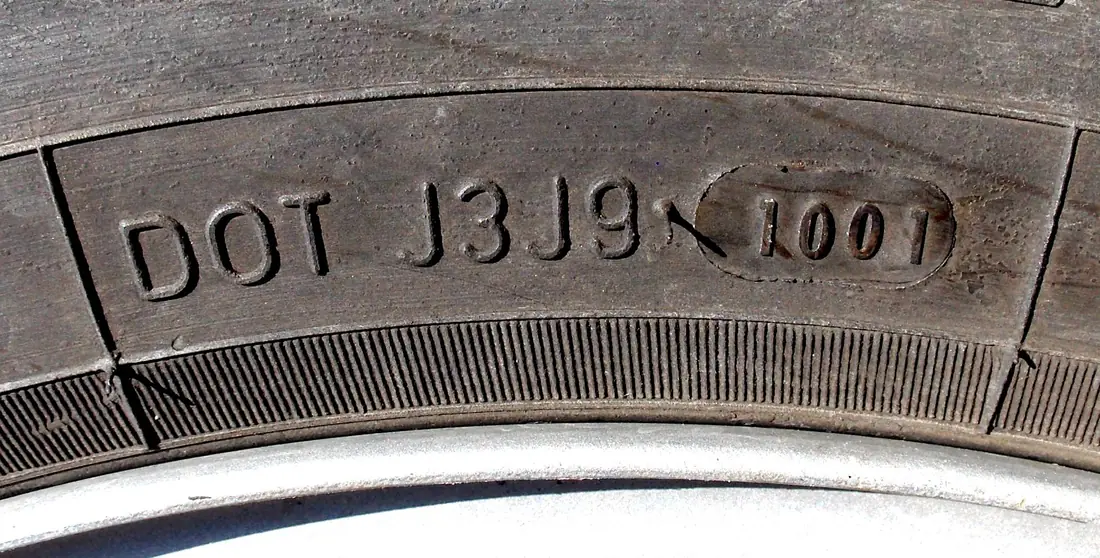

Goodyear's published guidance recommends replacing any tire in service six years or more, even if it looks fine, and never running a tire more than 10 years past its manufacture date. Many trailer owners use five to six years as their limit for ST tires on a hard-working dump trailer.
Signs a tire is overloaded or failing
Look for these at every walk-around:
- Sidewall bulges or blisters. These mean internal damage. Replace the tire.
- Cracking ("weather checking") in the sidewall or between tread blocks, a sign of age and UV damage
- Shoulder wear on both edges. This means underinflation or overload.
- Center wear. This means overinflation, which is less common on trailers.
- One-sided wear or cupping. Look for a bent axle, worn suspension bushings, or loose bearings. See Dump Trailer Axles and Suspension.
- Hot tires after a run. One tire much hotter than the others to the back of your hand points to low pressure, a dragging brake, or a failing bearing.
- Exposed cords or steel belts. Replace the tire immediately.
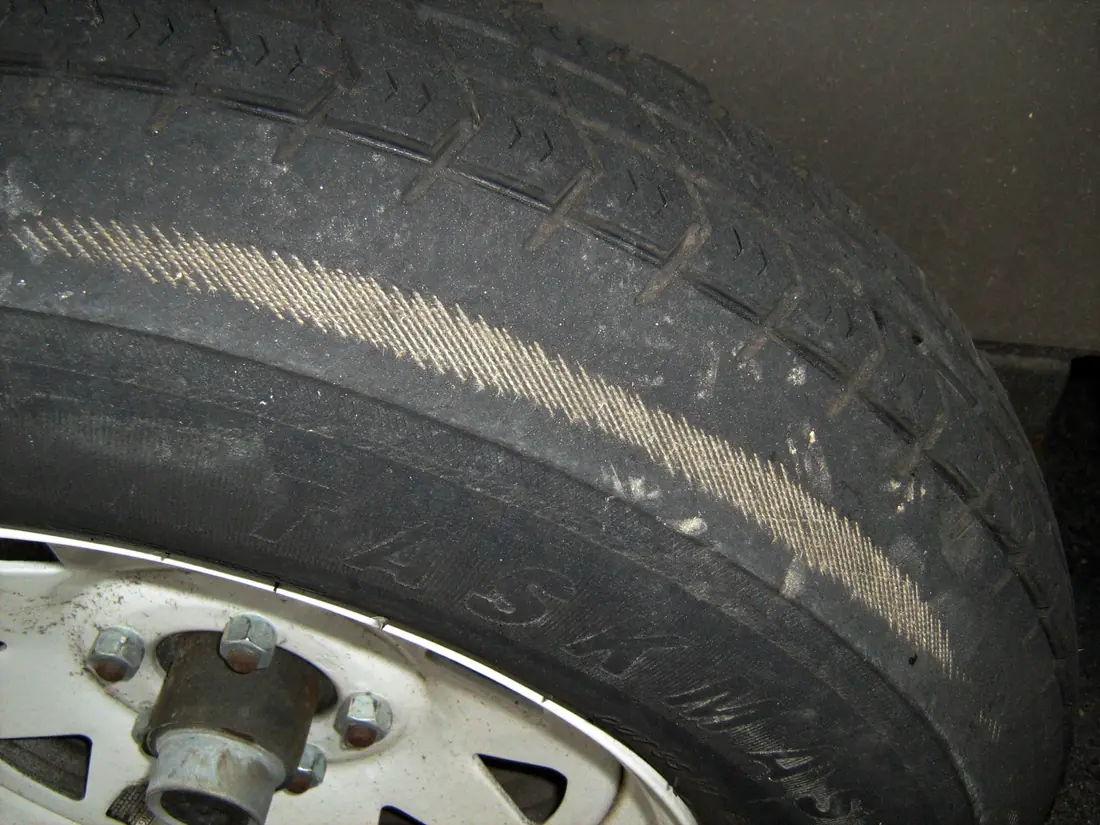

Ongoing checks belong in your maintenance checklist.
The spare tire
Many dump trailers don't come with a spare, or offer one as an option. On a tandem-axle trailer, you can limp to a safe spot on three tires at low speed. You can't do it far, and the remaining tire on that side is now carrying double.
What to carry:
- A mounted spare with the same size, load range, bolt pattern, and wheel rating as the others. A Load Range E spare on a Load Range G trailer is a weak link.
- A lug wrench that fits your lug nuts (often 13/16 in or 7/8 in on 8-lug trailer wheels; check yours) and a torque spec for retightening.
- A ramp-style tire changer or a jack rated for the trailer. On a tandem, you can drive the good tire up a ramp to lift the flat one off the ground.
Retorque lug nuts after the first 10, 25, and 50 miles on a newly mounted wheel, or follow the wheel or axle maker's schedule.
The bottom line
Pick dump trailer tires from the axle rating down. Divide each GAWR by the number of tires on that axle, then choose a tire whose sidewall max load beats that number with some margin. Check the wheel's rating too. Use ST or 17.5-inch commercial tires rather than LT where you can. Inflate to the label pressure cold, keep speed at or under 65 mph unless your tire is rated otherwise, and replace tires by the DOT date code as well as by tread. For more on what to look for in a whole trailer, see the dump trailer buying guide.
Frequently asked questions
What load range tire do I need for a 14,000-lb dump trailer?
Each tire must carry at least a quarter of the trailer's axle ratings. With two 7,000-lb axles, that is 3,500 lb per tire. A 3,420-lb Load Range E tire falls short; a 3,520-lb E, a Load Range G, or a 17.5-inch Load Range H tire clears it.
Can I put LT tires on a dump trailer?
You can, but an LT tire usually carries less than an ST tire of the same size and load range. An LT235/85R16 E is rated about 3,042 lb, compared with about 3,640 lb for an ST235/85R16 E. Make sure the tires on each axle still meet the axle's GAWR.
What PSI should dump trailer tires be?
Use the cold inflation pressure on the trailer's certification or tire label. Tire makers such as Carlisle recommend running ST tires at the maximum cold pressure on the sidewall. Check pressure before driving, never after, and never exceed the wheel's rated pressure.
How do I tell how old my trailer tires are?
Find the DOT code on the sidewall. The last four digits are the week and year of manufacture, so 2324 means the 23rd week of 2024.
Share this guide
Link to this guide
Writing about dump trailers? You're welcome to quote this guide and link to it. Copy whichever format you need.
- URL
- https://stranktrailers.com/guides/dump-trailer-tires
- HTML link
- <a href="https://stranktrailers.com/guides/dump-trailer-tires">Dump Trailer Tires: Load Range, Ply, and ST vs. LT</a> (Strank Trailers)
- Citation
- Strank Trailers. "Dump Trailer Tires: Load Range, Ply, and ST vs. LT." stranktrailers.com, October 28, 2026. https://stranktrailers.com/guides/dump-trailer-tires
Keep reading
Specs · 10 min read
GVWR, Payload, and Empty Weight Explained
GVWR is the most a loaded trailer may weigh. Payload is GVWR minus empty weight. How to read the label, find real payload, and check tongue weight and GCWR.
Specs · 10 min read
Dump Trailer Axles and Suspension
Dump trailer axles and suspension explained: 5.2k to 12k axle ratings, tandem vs. triple, slipper springs vs. torsion, hubs, and axle capacity vs. GVWR.
Ownership · 9 min read
Dump Trailer Maintenance Checklist
A dump trailer maintenance checklist with pre-trip, weekly, monthly, and annual tasks: lug nut torque, bearings, brakes, hydraulic fluid, grease points, rust.