
Dump Trailer vs. Dump Truck
Dump trailer vs. dump truck compared on 2026 cost, CDL rules, payload per trip, maintenance, and flexibility, plus when each one is the better investment.
By Strank Trailers9 min read
The short version
- A 14,000 lb dump trailer carries about 5 tons per load; a tandem-axle dump truck typically carries about 12 to 15 tons, depending on state weight laws.
- A dump trailer costs a fraction of a dump truck up front, especially if you already own a 3/4-ton or 1-ton pickup.
- Most dump trucks need a Class B CDL for commercial use; a pickup and dump trailer can stay non-CDL if the trailer is 10,000 lb GVWR or less or the combined rating stays under 26,001 lb.
- Trailers have no engine, transmission, or emissions system, so they cost far less to maintain, but they put towing wear on your truck.
- Dump trailers win for mixed work, smaller jobs, and growing businesses; dump trucks win when you haul aggregate or dirt by the ton all day.
On this page
- Dump trailer vs. dump truck at a glance
- How much does a dump trailer cost compared to a dump truck?
- How much can each one haul per trip?
- Do you need a CDL for a dump trailer or a dump truck?
- Maintenance and operating costs
- Flexibility: one tool or two
- Maneuvering and job-site access
- When a dump trailer wins
- When a dump truck wins
- The bottom line
A dump trailer is the better choice for most small contractors, landscapers, and new hauling businesses. It costs a fraction of a dump truck, it can often be towed without a CDL, it has no engine to maintain, and the truck pulling it can do other work. A dump truck wins when you haul heavy material by the ton all day: a tandem-axle truck carries roughly two to three times as much per load as a typical 14,000 lb dump trailer, in one rigid, maneuverable unit.
The real question is how many tons you move per week and how much of your truck's time is spent hauling. Here is how the two compare.
Dump trailer vs. dump truck at a glance
| Factor | Dump trailer (14,000 lb, bumper pull) | Tandem-axle dump truck |
|---|---|---|
| Typical payload | About 9,500–10,300 lb (about 5 tons) | About 24,000–30,000 lb (12–15 tons) |
| New price (2026) | Roughly $9,000–$18,000 | Roughly $150,000–$250,000+ |
| License for commercial use | Often non-CDL; Class A if over thresholds | Class B CDL |
| Engine maintenance | None (truck wears instead) | Engine, transmission, emissions, PTO |
| Flexibility | Unhook and use the truck for other work | Single-purpose |
| Maneuvering | Long combination, trailer backing | Single rigid unit |
Prices vary by region, options, dealer, and spec. Weight limits vary by state.
How much does a dump trailer cost compared to a dump truck?
The upfront gap is large.
Dump trailers (2026, new):
- 5x10 to 6x12, 7,000 to 12,000 lb GVWR: roughly $5,500 to $11,000.
- 7x14, 14,000 lb GVWR: roughly $9,000 to $18,000, depending on frame, floor gauge, hoist, and options.
- 16 to 20 ft goosenecks, 20,000 to 30,000 lb GVWR: roughly $15,000 to $35,000 or more.
See How Much Does a Dump Trailer Cost? for a deeper breakdown.
If you already own a properly rated 3/4-ton or 1-ton pickup, the trailer is the whole investment. If you need to buy the truck too, add that cost, though you also get a truck that can do everything else.
Dump trucks:
- New tandem-axle dump trucks commonly list from about $150,000 to over $250,000 in 2026, depending on chassis, engine, body, and spec. Current new listings on TruckPaper, for example, run from the high $100,000s to the high $200,000s.
- New single-axle (Class 6 and 7) dump trucks generally cost less, often starting somewhere around $90,000 and rising with spec.
- Used trucks narrow the gap. One 2026 market guide puts the most commonly traded used tandem-axle trucks at about $50,000 to $130,000 with 80,000 to 250,000 miles, and used single-axle trucks at about $18,000 to $85,000.
Two federal taxes also tend to land on trucks and not trailers:
- Federal excise tax (FET). The IRS imposes a 12 percent retail excise tax on new truck chassis and bodies rated over 33,000 lb GVWR, and on trailers rated over 26,000 lb. Most dump trailers are rated 26,000 lb or less, so they fall under that threshold. Many tandem dump trucks do not.
- Heavy Vehicle Use Tax. Vehicles with a taxable gross weight of 55,000 lb or more must file IRS Form 2290 and pay $100 to $550 a year. Many tandem dump trucks register at weights that trigger it. A pickup and dump trailer usually register far below that.
How much can each one haul per trip?
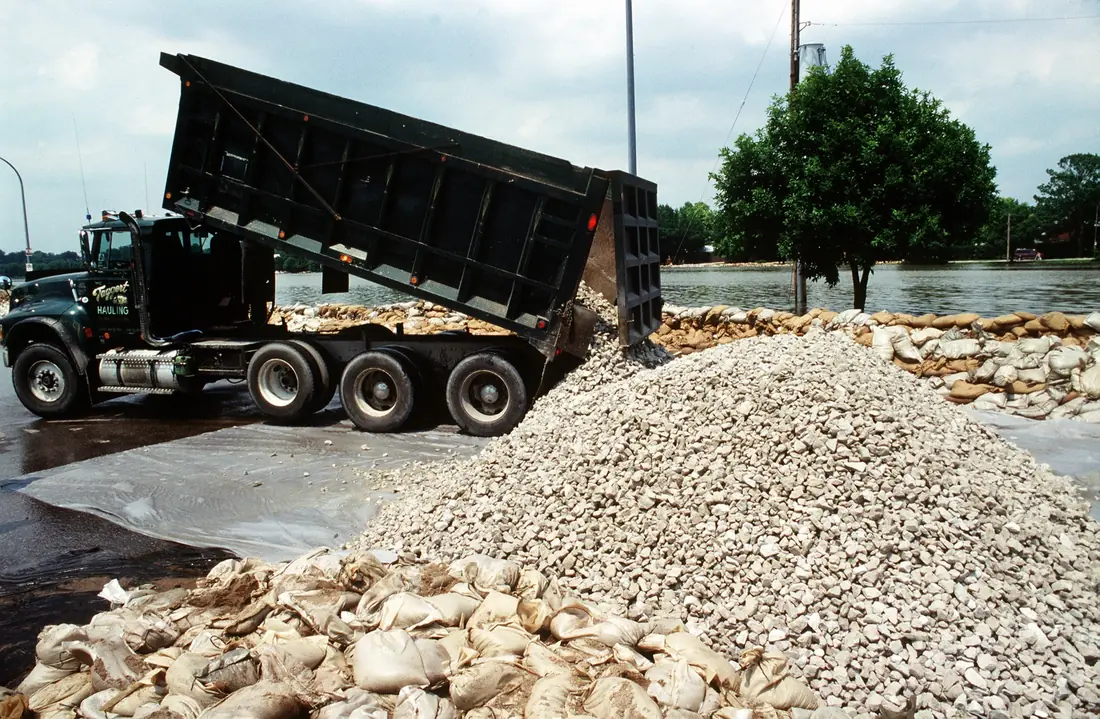
Here is the comparison that decides it for many businesses. Figures use about 2,800 lb per cubic yard of gravel. Your material and state limits will change the numbers.

| Setup | Typical payload | Tons | Gravel per load |
|---|---|---|---|
| 7x14 dump trailer, 14,000 lb GVWR | 9,500–10,300 lb | 4.75–5.15 | 3.4–3.7 yd³ |
| Gooseneck dump trailer, 20,000 lb GVWR | 12,500–13,500 lb | 6.25–6.75 | 4.5–4.8 yd³ |
| Tandem-dual gooseneck, 25,000 lb GVWR | 16,500–19,000 lb | 8.25–9.5 | 5.9–6.8 yd³ |
| Single-axle dump truck | 10,000–16,000 lb | 5–8 | 3.6–5.7 yd³ |
| Tandem-axle dump truck | 24,000–30,000 lb | 12–15 | 8.6–10.7 yd³ |
The trailer payloads come from published manufacturer specs (for example, PJ lists 10,340 lb for its 14,000 lb D7 and 17,500 to 19,160 lb for its 25,000 lb DD). Truck payloads depend on the truck's empty weight and on state axle and gross weight limits under the federal bridge formula, so treat those as typical ranges, not promises.
If you deliver 30 tons of stone in a day, that is two to three loads in a tandem truck and about six in a 14,000 lb trailer. Each extra load costs fuel, labor, and time at the scale. That is where trucks earn their price.
Our load calculator shows how many yards of a given material your trailer can legally carry.
Do you need a CDL for a dump trailer or a dump truck?
Licensing is one of the biggest practical differences.
Dump trucks. Most single-axle and nearly all tandem-axle dump trucks are rated 26,001 lb GVWR or more. Under 49 CFR 383.91, that makes them a Group B vehicle, which needs a Class B CDL when used in commerce. Some lighter Class 6 dump trucks are rated under 26,001 lb, but they carry less.
Dump trailers. A truck and trailer need a Class A CDL for commercial use when the trailer is rated over 10,000 lb GVWR and the combination is rated 26,001 lb or more. Federal rules define the combined rating (GCWR) as the greater of the truck manufacturer's GCWR, if shown on the federal certification label, or the sum of the truck's and trailer's ratings. That leaves some non-CDL room:
- A trailer rated 10,000 lb GVWR or less does not trigger Class A by itself.
- A 14,000 lb trailer behind a truck rated around 10,000 lb GVWR can stay under 26,001 lb combined, depending on how the truck is rated.
- A 20,000 lb or heavier gooseneck behind a 1-ton almost always crosses into Class A territory.
CDL drivers also come with drug and alcohol testing requirements and are harder to hire. If you plan to put employees in the driver's seat, a non-CDL setup widens the pool. These rules are easy to get wrong and states add their own, so read Do You Need a CDL to Pull a Dump Trailer? and DOT Numbers, Inspections, and Registration for Dump Trailers before you buy.
Separately, in interstate commerce any truck or truck-and-trailer rated 10,001 lb or more is a commercial motor vehicle and generally needs a USDOT number. That applies to a 14,000 lb trailer setup and a dump truck alike.
Maintenance and operating costs
A dump trailer has no engine, transmission, diesel exhaust fluid system, diesel particulate filter, or power take-off. Its maintenance list is short:
- Wheel bearings and hubs (repack or check oil-bath hubs)
- Tires
- Brakes and breakaway system
- Hydraulic pump, cylinder, hoses, and fluid
- Battery and charging
- Wiring and lights
- Hinges, gate latches, and grease points
See the dump trailer maintenance checklist for intervals.
A dump truck has all of that plus a heavy diesel engine, transmission, emissions equipment, cab, steering, air brakes, and a hoist system. Repair bills are bigger, and when the truck is down, the whole operation is down.
The trailer is not free to run, though. Towing near capacity is hard on a pickup. Expect faster wear on brakes, tires, transmission, and suspension, and lower fuel economy. When you compare costs, include that wear on the pickup.
Flexibility: one tool or two
This is where dump trailers shine.
- The truck does other work. Unhook the trailer and the pickup can haul a crew, tow an equipment trailer, or plow snow.
- Drop and go. Leave the trailer at a job for a crew to fill while you run another errand, or run two trailers with one truck.
- It hauls equipment. A dump trailer with slide-in ramps can move a skid steer or mini excavator, within its payload.
- Lower stakes. If work slows, a parked trailer costs little. A parked dump truck still has insurance, registration, and a loan payment.
A dump truck is single-purpose, but it is very good at that purpose. It loads, hauls, and dumps in one unit, and tailgate spreading from a truck is fast and controlled.
Maneuvering and job-site access
A crew-cab pickup plus a 14 ft dump trailer runs roughly 40 ft or more overall. That combination needs room to turn and someone comfortable backing a trailer into tight spots. A dump truck is a single rigid vehicle that is usually shorter overall and easier to place exactly where you want the load.
On the other hand, a pickup and trailer is lighter on residential driveways, and the trailer can be unhooked and left where a truck could not stay. For homeowner and landscaping work, that often favors the trailer.
When a dump trailer wins
- You haul a few loads a day, not dozens.
- Your work is mixed: some hauling, some equipment moving, some crew transport.
- You are starting a business and want to limit upfront cost and risk.
- You want to avoid CDL requirements for yourself or your employees.
- You already own a capable 3/4-ton or 1-ton truck.
When a dump truck wins
- You deliver aggregate, dirt, or asphalt by the ton every day.
- Trip count drives your profit, so payload per trip matters more than upfront cost.
- You already have CDL drivers and a maintenance program.
- Your jobs need precise placement and tailgate spreading in tight sites.
Many businesses do both: they start with a trailer, then add a truck once they have steady volume to keep it busy.
The bottom line
A dump trailer gives you most of the capability of a dump truck for a fraction of the cost, with simpler licensing and far less maintenance, as long as your volume fits its payload. When hauling becomes the whole business and you are moving tons all day, a dump truck's payload per trip pays for itself. Count your tons per week, check the CDL thresholds that apply to you, and choose the tool that matches the work.
Frequently asked questions
Is a dump trailer cheaper than a dump truck?
Yes, by a wide margin. In 2026 a 14,000 lb dump trailer typically costs roughly $9,000 to $18,000 depending on build and options, while new tandem-axle dump trucks commonly list from about $150,000 to over $250,000. Used trucks narrow the gap but bring higher maintenance costs.
How many tons can a dump trailer carry compared to a dump truck?
A 14,000 lb GVWR dump trailer carries about 4.75 to 5 tons, and a 25,000 lb tandem-dual gooseneck about 8 to 9.5 tons. A tandem-axle dump truck typically carries 12 to 15 tons legally, and a single-axle truck about 5 to 8 tons.
Do I need a CDL for a dump trailer or a dump truck?
For commercial use, a dump truck rated 26,001 lb GVWR or more requires a Class B CDL. A truck and dump trailer require a Class A CDL when the trailer is rated over 10,000 lb and the combination is rated 26,001 lb or more. State rules vary, especially for farm and private use.
Should I start a hauling business with a dump trailer or a dump truck?
Most small operators start with a dump trailer because the upfront cost, insurance, and licensing hurdles are lower, and the truck can do other work. Moving to a dump truck makes sense once you have steady, high-volume hauling that keeps it busy.
Share this guide
Link to this guide
Writing about dump trailers? You're welcome to quote this guide and link to it. Copy whichever format you need.
- URL
- https://stranktrailers.com/guides/dump-trailer-vs-dump-truck
- HTML link
- <a href="https://stranktrailers.com/guides/dump-trailer-vs-dump-truck">Dump Trailer vs. Dump Truck</a> (Strank Trailers)
- Citation
- Strank Trailers. "Dump Trailer vs. Dump Truck." stranktrailers.com, October 28, 2026. https://stranktrailers.com/guides/dump-trailer-vs-dump-truck
Keep reading
Buying · 8 min read
How Much Does a Dump Trailer Cost in 2026?
Dump trailer cost in 2026: real price ranges by size and GVWR, option prices, used values, taxes and registration, and what it costs to own one each year.
Towing · 9 min read
Do You Need a CDL to Pull a Dump Trailer?
When a dump trailer requires a CDL: the federal 26,001 lb / 10,000 lb Class A rule, how GCWR is calculated, worked truck-and-trailer examples, and state rules.
Towing · 11 min read
DOT Numbers, Inspections, and Registration for Dump Trailers
Dump trailer DOT requirements explained: when you need a USDOT number, medical card, annual inspection, IFTA/IRP, and how trailer titles and plates work.