
Best Dump Trailers for Contractors and Construction
The best dump trailers for construction: GVWR from 14,000 to 30,000 lb, 7 gauge floors, I-beam frames, hoists, and goosenecks for demo, concrete, and rock.
By Strank Trailers11 min read
The short version
- For construction, treat 14,000 lb GVWR as the starting point and look at 20,000 to 30,000 lb trailers if you haul concrete, rock, or fill every day.
- A 7 gauge floor (about 0.179 in) is roughly a third thicker than 10 gauge (about 0.135 in) and holds up far better when a loader or excavator drops material in.
- Heavier trailers carry more, but not proportionally more: a 20,000 lb trailer typically carries only 2,000 to 3,500 lb more than a 14,000 lb trailer because its frame and axles weigh more.
- Above about 16,000 lb GVWR, goosenecks and pintle hitches are the norm, and most setups at that size require a Class A CDL for commercial use.
- Frame depth, crossmember spacing, axle ratings, and hoist size tell you more about a construction trailer's life than its paint or price.
On this page
- What do construction materials weigh?
- How much GVWR does a construction dump trailer need?
- Floor and side thickness: why 7 gauge matters
- Frame: I-beam depth and crossmembers
- Hoist: scissor, telescopic, or dual-ram
- Gooseneck, bumper pull, or pintle?
- Axles, tires, and brakes
- Representative dump trailers for construction
- CDL and DOT considerations
- What do construction dump trailers cost in 2026?
- The bottom line
The best dump trailer for construction work is one rated for your real loads with margin, built to take abuse from a loader bucket. For general contracting and light demolition, that usually means a 7x14 or 7x16 rated 14,000 to 17,600 lb GVWR. For daily concrete, rock, asphalt, and fill hauling, look at 16 to 20 ft goosenecks rated 20,000 to 30,000 lb, with a 7 gauge floor, a 10 to 12-inch I-beam frame, 10,000 lb axles, and a hoist sized well above the payload.
Construction is the hardest job a dump trailer does. Materials are dense, they are loaded by machines, and the trailer runs full most days. That is exactly where the differences between trailers show up. This guide covers what to look for and describes representative models fairly from their published specs.
What do construction materials weigh?
Most construction material is heavy enough that the trailer's weight limit, not the box, decides the load.
| Material | Approx. weight per cubic yard | Notes |
|---|---|---|
| Concrete, solid | About 4,000 lb | Roughly 150 lb per cubic foot |
| Broken concrete, loose | About 1,400–2,700 lb | Depends on chunk size and packing |
| Asphalt millings, loose | About 2,700 lb | Heavier when compacted |
| Crushed stone, gravel | 2,800–3,000 lb | Varies by stone and gradation |
| Fill dirt, clay | About 2,000–2,800 lb | Wet clay is at the high end |
| Mixed demolition debris | Highly variable | Bulky, but masonry and tile add up fast |
Moisture changes everything. Wet soil can weigh 20 to 30 percent more than dry. When in doubt, use your supplier's or landfill's scale ticket. See the material weight chart for more.
Here is what that means in practice. A 7x16 with 24-inch sides holds about 8.2 cubic yards level-full. On a 20,000 lb trailer with roughly 12,500 lb of payload, that is enough room for about 5 yards of broken concrete or 4.5 yards of crushed stone. The rest of the box is air. For bulky demolition debris, the box fills before the weight limit, so taller sides help. For concrete and rock, they mostly add steel. Our load calculator runs the numbers for your trailer.
How much GVWR does a construction dump trailer need?
Start with the payload you need on a typical day, then pick the class. Payload is GVWR minus the trailer's empty weight.
| GVWR class | Typical payload | Representative models | Typical tow setup |
|---|---|---|---|
| 14,000 lb | 9,500–10,500 lb | Big Tex 14LP, PJ D7 | 3/4- or 1-ton, bumper pull |
| 15,400–17,600 lb | 10,000–12,500 lb | PJ DL and DM, Big Tex 16GX | 1-ton, bumper pull or gooseneck |
| 20,000–21,000 lb | 12,400–13,400 lb | Load Trail DH20 and HG20, PJ DE | 1-ton gooseneck or medium-duty |
| 25,000–30,000 lb | 16,500–20,000 lb | PJ DD, Big Tex 25DU, Diamond C WDT | 1-ton dual rear wheel or larger |
Payload figures come from published manufacturer and dealer specs and vary by length and options.
Notice that payload does not climb as fast as GVWR. A 20,000 lb trailer typically carries only 2,000 to 3,500 lb more than a 14,000 lb trailer, because its deeper frame, heavier floor, bigger axles, and larger tires add thousands of pounds of empty weight. That is not wasted weight. It is the steel that lets the trailer survive years of full loads.
Floor and side thickness: why 7 gauge matters
Steel gauge numbers run backward: the lower the number, the thicker the steel. Typical sheet steel thicknesses:
| Gauge | Approx. thickness |
|---|---|
| 12 gauge | 0.105 in |
| 10 gauge | 0.135 in |
| 7 gauge | 0.179 in |
A 7 gauge floor is about a third thicker than 10 gauge. That matters when an excavator drops a bucket of broken concrete from a few feet up. Thinner floors dent between crossmembers, the dents hold water, and the steel rusts from the inside out. A 7 gauge floor is the usual recommendation for any trailer loaded by machines with rock, concrete, or demolition debris.
Side walls take less direct impact, so 10 gauge sides are common even on heavy trailers. Some heavy-duty models, like the PJ DE, use 7 gauge sides as well.
Crossmember spacing matters as much as floor thickness. Crossmembers on 16-inch centers are common; closer spacing supports the floor better under point loads. The steel gauge guide covers this in more detail.
Frame: I-beam depth and crossmembers
The main frame carries the load to the axles and the hitch. On construction trailers, look for:
- I-beam main rails. Heavier construction dump trailers generally use I-beams rather than channel. Depth and weight per foot both matter: an 8-inch, 10 lb per foot I-beam is common at 14,000 lb, while 20,000 lb and heavier trailers often use 10 or 12-inch beams. PJ, for example, specifies a 10-inch, 19 lb I-beam on its 21,000 lb DE and a 12-inch, 19 lb I-beam on its 25,000 lb DD.
- A continuous tongue or neck. The tongue (or gooseneck) should be a full beam tied into the main frame, not a short section welded on.
- Crossmembers of channel or tube, on 16-inch centers or closer, fully welded to the main rails.
See Dump Trailer Frames: I-Beam, Channel, Tube, and Crossmembers for how to compare them.
Hoist: scissor, telescopic, or dual-ram
The hoist has to lift the full payload, plus whatever material sticks to the front of the box.
- Dual-ram systems use two cylinders under the box. They are common on lighter trailers and less common in heavy construction classes.
- Scissor hoists use a cylinder working through a folding linkage under the box. They are compact, lift well for their size, and are used on many construction trailers, including the Big Tex 14LP, Big Tex 16GX, Load Trail DH20 and HG20, and PJ DE. PJ's 25,000 lb DD uses dual scissor cylinders.
- Telescopic cylinders mount at the front of the box and extend in stages. Diamond C uses them across its dump line and describes them as handling unevenly distributed loads better than scissor hoists, with a 45-degree dump angle. They are a common choice on very heavy trailers.
For construction, look at cylinder size and the published dump angle. Load Trail lists a 45-degree dump angle on the HG20, for example. Wet clay and frozen fill hang up in the box, so a steeper angle and plenty of lift capacity help. See Scissor Hoist vs. Telescopic vs. Dual-Ram Dump Trailers.
Gooseneck, bumper pull, or pintle?
At 14,000 lb, a bumper pull is the norm. Above about 16,000 lb, most construction dump trailers are goosenecks, because a gooseneck puts its hitch weight over the truck's rear axle and tows more steadily under heavy loads.
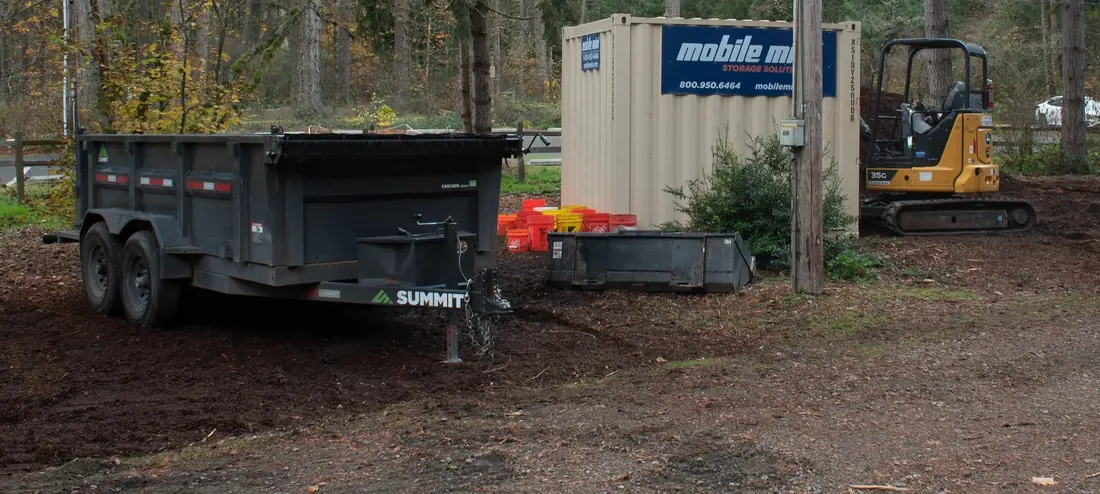

Pintle hitches, a hook-and-ring coupling, are common in construction fleets that tow with medium-duty trucks. The Load Trail DH20, for example, ships with a 3-inch pintle coupler standard. See Gooseneck vs. Bumper Pull Dump Trailers for the full comparison.
Axles, tires, and brakes
On heavy trailers, the running gear is where weight ratings live.
- Axles. 7,000 lb axles are typical at 14,000 lb; 8,000 lb at 16,000 to 17,500 lb; 10,000 lb at 20,000 lb and up. Oil-bath hubs make bearing checks easier than grease-packed hubs. Torsion axles, used on the Load Trail DH20 and HG20 and the PJ DE, can lower the deck; leaf springs are simpler to repair.
- Tires. 17.5-inch Load Range H tires, such as the ST215/75 R17.5 LRH on the Big Tex 16GX and Load Trail HG20, carry more load per tire than 16-inch Load Range E. Tandem dual trailers spread the load over eight tires.
- Brakes. Electric brakes on every axle and a breakaway system are standard on these classes. Check that your brake controller is set for the loaded weight.
Representative dump trailers for construction
These are representative models from major builders, described from published specs. They are not rankings, and many other builders make capable trailers. Specs change by model year and options, so check the current spec sheet and the trailer's VIN plate.
| Model | Hitch | GVWR | Floor / frame | Hoist |
|---|---|---|---|---|
| Big Tex 14LP | Bumper pull | 14,000 lb | 10 ga (7 ga opt.), 8 in I-beam | Scissor |
| PJ DM | Bumper pull | 15,400–16,800 lb | 7 ga, 8 in I-beam | Scissor |
| Big Tex 16GX | Gooseneck | 17,500 lb | 7 ga, 8 in I-beam, 10 in neck | Scissor |
| Load Trail DH20 | Pintle | 20,000 lb | 7 ga, 12 in I-beam | Scissor |
| Load Trail HG20 | Gooseneck | 20,000 lb | 7 ga, 12 in I-beam | Scissor |
| PJ DE | Bumper pull (gooseneck opt.) | 21,000 lb | 7 ga, 10 in I-beam | Scissor |
| PJ DD | Gooseneck | 25,000 lb | 10 ga, 12 in I-beam | Dual scissor |
| Big Tex 25DU | Gooseneck | 25,000 lb | 7 ga, 12 in I-beam | Scissor |
| Diamond C WDT | Gooseneck | 25,000–30,000 lb | 10 ga sides | Telescopic |
14,000 to 17,500 lb: general contracting and light demolition
The Big Tex 14LP is a common 7x14 contractor trailer: 83 inches wide in 12, 14, and 16 ft lengths, 14,000 lb GVWR, with an 8-inch I-beam frame, a 10 gauge floor (7 gauge available), a scissor hoist, a combo gate, and slide-in ramps. For machine-loaded rock and concrete, the 7 gauge floor upgrade is worth considering.
The PJ DM is a low-profile high-side dump with 36 to 48-inch sides. Dealer-published specs list a 7 gauge floor, 10 gauge walls, and an 8-inch I-beam frame, with GVWR of 15,400 to 16,800 lb. The tall sides suit bulky demolition and cleanout debris.
The Big Tex 16GX is a gooseneck in 14 and 16 ft lengths rated 17,500 lb, with a 7 gauge floor, an 8-inch I-beam frame with a 10-inch I-beam neck, 3-inch channel crossmembers on 16-inch centers, two 8,000 lb oil-bath axles, and 17.5-inch Load Range H tires. Big Tex lists 12,220 to 12,520 lb of payload.
20,000 to 21,000 lb: concrete, rock, and fill
The Load Trail DH20 (pintle) and HG20 (gooseneck) share a 20,000 lb rating, a 12-inch I-beam frame, a 7 gauge floor, two 10,000 lb Dexter torsion axles, and 17.5-inch Load Range H tires. Load Trail lists 12,410 to 12,950 lb of payload on the DH20, a scissor hoist, and 96-inch slide-in ramps.
The PJ DE is a heavy low-profile dump, 82.5 inches by 16 ft, rated 21,000 lb, with a 10-inch, 19 lb I-beam frame, 7 gauge floor, 36-inch 7 gauge sides, two 10,000 lb torsion axles on 17.5-inch tires, and a 6 x 21-inch scissor cylinder. PJ lists 13,400 lb of load capacity. It comes as a bumper pull with a gooseneck option.
25,000 to 30,000 lb: high-volume hauling
The PJ DD is a 96-inch by 20 ft tandem dual gooseneck rated 25,000 lb, with a 12-inch I-beam frame, a 10 gauge bed, 36-inch removable sides, and dual scissor cylinders. PJ lists 17,500 to 19,160 lb of payload and more than 17 cubic yards of capacity.
The Big Tex 25DU is a 92-inch by 20 ft tandem dual gooseneck with a 12-inch I-beam frame, 7 gauge floor, 48-inch sides, and a scissor hoist. Big Tex dealer specs list 25,000 lb GVWR and 16,500 lb of payload.
The Diamond C WDT is a 96-inch tandem dual gooseneck in 16 to 20 ft lengths, rated 25,000 lb standard or 30,000 lb with upgrades. It uses a telescopic cylinder with a 45-degree dump angle and offers a gas-powered hydraulic unit as an upgrade.
At this size you are competing with a dump truck on capacity, so it is worth pricing both before you buy.
CDL and DOT considerations
Heavy dump trailers come with licensing obligations. Under federal rules:
- A Class A CDL is required for commercial use when the trailer is rated over 10,000 lb GVWR and the truck-and-trailer combination is rated 26,001 lb or more. Every 20,000 lb trailer behind a pickup crosses that line.
- In interstate commerce, any truck or truck-and-trailer rated 10,001 lb or more is a commercial motor vehicle and generally needs a USDOT number.
States add their own rules, especially for intrastate work. Read Do You Need a CDL to Pull a Dump Trailer? before you buy above 14,000 lb.
What do construction dump trailers cost in 2026?
Prices vary by builder, region, options, and dealer. As rough 2026 ranges for new trailers:
- 14,000 lb bumper pull, 7x14 to 7x16: about $9,000 to $18,000
- 16,000 to 21,000 lb, bumper pull or gooseneck: about $14,000 to $26,000
- 25,000 to 30,000 lb tandem dual gooseneck: about $22,000 to $35,000 or more
A 7 gauge floor, higher sides, upgraded axles and tires, telescopic hoists, and tarp systems add cost. Over the life of a construction trailer, those upgrades usually cost less than the repairs and downtime they prevent.
The bottom line
For contractors, buy GVWR for the loads you haul every day, with margin. A 14,000 lb trailer is the starting point for general work. For concrete, rock, and fill, a 20,000 lb or heavier gooseneck with a 7 gauge floor, a deep I-beam frame, 10,000 lb axles, and a well-sized hoist is built for the job. Compare spec sheets line by line, inspect the welds and floor in person, and plan for the CDL requirements that come with heavy trailers.
Frequently asked questions
What is the best size dump trailer for construction?
For general contracting and light demolition, a 7x14 or 7x16 at 14,000 to 17,600 lb GVWR covers most work. For daily concrete, rock, and fill hauling, a 16 to 20 ft gooseneck rated 20,000 to 30,000 lb carries more per trip and is built for the duty cycle.
How much concrete can a dump trailer haul?
Solid concrete weighs about 4,000 lb per cubic yard, and broken concrete typically weighs about 1,400 to 2,700 lb per yard depending on piece size and packing. A 14,000 lb trailer with about 10,000 lb of payload can carry roughly 4 yards of loose broken concrete; a 20,000 lb trailer with about 12,500 lb of payload, roughly 5 yards.
Is a 7 gauge or 10 gauge floor better for a dump trailer?
For construction, 7 gauge is better. It is about 0.179 inches thick versus about 0.135 inches for 10 gauge, so it resists dents and holes from dropped concrete, rock, and demolition debris much better. It adds weight, which slightly reduces payload.
Do I need a CDL for a 20,000 lb dump trailer?
For commercial use, almost certainly. Federal rules require a Class A CDL when the trailer is rated over 10,000 lb and the truck-and-trailer combination is rated 26,001 lb or more, which any 20,000 lb trailer behind a pickup will exceed. Some state exemptions exist for farm and private use.
Should a construction dump trailer have a scissor or telescopic hoist?
Both work well when properly sized. Scissor hoists are compact and common on low-profile and many heavy-duty trailers. Telescopic cylinders are generally favored for very heavy, sticky, or off-center loads and for steep dump angles. What matters most is that the hoist's capacity is well above the trailer's payload.
Share this guide
Link to this guide
Writing about dump trailers? You're welcome to quote this guide and link to it. Copy whichever format you need.
- URL
- https://stranktrailers.com/guides/best-dump-trailers-for-construction
- HTML link
- <a href="https://stranktrailers.com/guides/best-dump-trailers-for-construction">Best Dump Trailers for Contractors and Construction</a> (Strank Trailers)
- Citation
- Strank Trailers. "Best Dump Trailers for Contractors and Construction." stranktrailers.com, October 28, 2026. https://stranktrailers.com/guides/best-dump-trailers-for-construction
Keep reading
Business · 10 min read
Material Weight Chart: Gravel, Dirt, Sand, Mulch, and More
Material weight chart in pounds and tons per cubic yard for gravel, dirt, sand, mulch, concrete, and debris, plus how many yards a dump trailer can haul.
Specs · 10 min read
Dump Trailer Steel Gauge Explained
Dump trailer steel gauge explained: 14, 12, 10, and 7 gauge in inches and pounds, what builders use for floors and sides, and why floor gauge matters most.
Specs · 11 min read
Dump Trailer Frames: I-Beam, Channel, Tube, and Crossmembers
How dump trailer frames are built: I-beam vs. channel vs. tube rails, beam size and weight per foot, crossmember spacing, tongue design, and rear hinges.