
Best Dump Trailers for Landscapers
The best dump trailers for landscaping: the size, side height, gate, ramp, tarp, and payload specs that matter, with representative models compared fairly.
By Strank Trailers11 min read
The short version
- For most landscaping crews, the best fit is a 6x12 or 7x14 tandem-axle dump trailer rated 10,000 to 14,000 lb GVWR with a combo gate, slide-in ramps, and a tarp.
- Mulch is light enough to fill a 4 ft box; gravel, topsoil, and sand hit the weight limit with the box only a quarter to a third full.
- A combo gate (barn doors plus spreader) lets you dump piles, spread driveway base, and load equipment from the same trailer.
- A low deck and slide-in ramps matter if you also haul mowers or compact equipment.
- At the same size and GVWR, frames, floors, and hoists vary widely between builders, so compare spec sheets line by line.
On this page
The best dump trailer for most landscapers is a 6x12 or 7x14 tandem-axle trailer rated 10,000 to 14,000 lb GVWR, with a combo gate (barn doors plus a spreader gate), slide-in ramps, a roll tarp, and either 3 to 4 ft sides or removable mesh extensions for mulch. Lawn maintenance crews that mainly haul clippings, brush, and the occasional few yards of mulch can do well with a lighter 5x10 or 6x10 around 7,000 to 10,000 lb GVWR.
Brand matters less than the specs underneath. This guide covers what landscapers actually haul, the features worth paying for, and representative models from published specs so you can compare them fairly.
What do landscapers haul, and what does it weigh?
Landscaping is unusual because the materials range from very light to very heavy. That makes it easy to buy the wrong trailer.
| Material | Approx. weight per cubic yard | What limits the load |
|---|---|---|
| Mulch, wood chips (dry) | 400–800 lb | Box volume |
| Mulch (wet) | 1,000–1,500+ lb | Often volume, sometimes weight |
| Leaves, brush, green waste | Light and variable | Box volume |
| Topsoil (dry, screened) | 1,500–2,200 lb | Weight |
| Sand (dry) | About 2,700 lb | Weight |
| Gravel, crushed stone | 2,800–3,000 lb | Weight |
Weights vary with moisture and source. Wet material can weigh 20 to 30 percent more than dry, and wet mulch can weigh two to three times as much as dry. See the material weight chart for more.
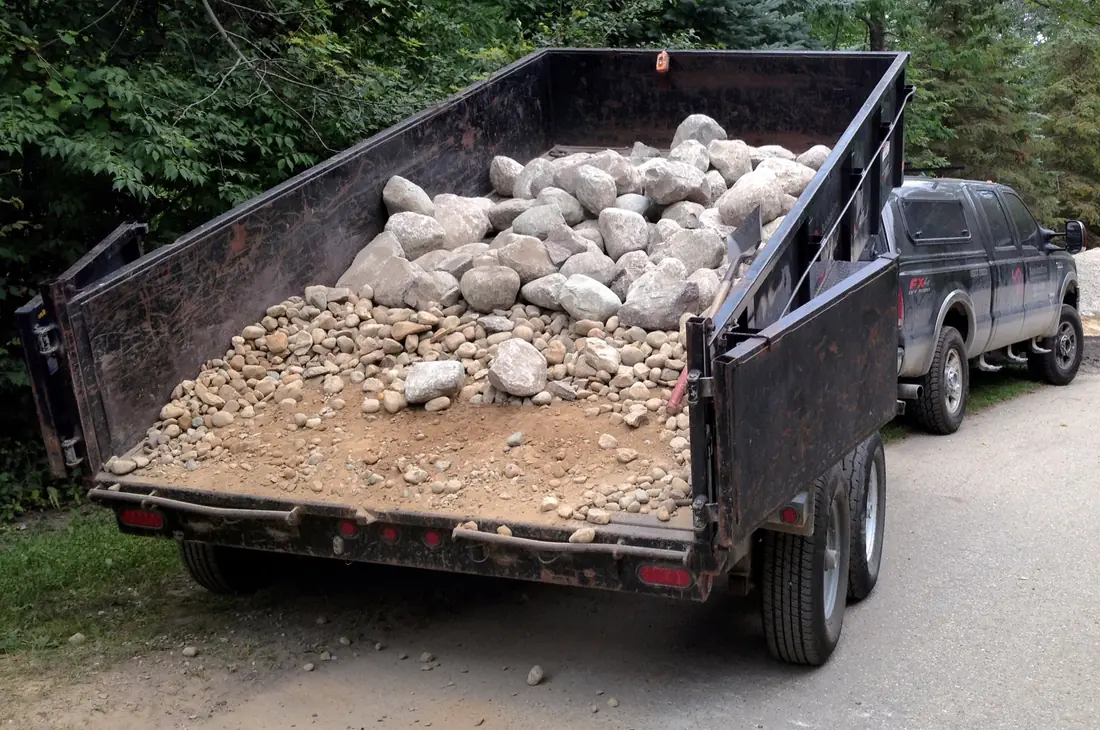
Two very different trailers hide in that table. For mulch and brush, you need volume: tall sides and a long box. For gravel, soil, and stone, you need payload. A 7x14 rated 14,000 lb GVWR can carry only about 3.3 to 3.7 cubic yards of gravel before it hits its legal limit, no matter how tall the sides are. Our load calculator runs the numbers for your trailer.

Features that matter most in a landscaping dump trailer
Size and payload
Pick your trailer by the heaviest load you haul regularly, not the heaviest one you can imagine.
- 5x10 to 6x10, 7,000 to 9,990 lb GVWR: Maintenance crews, small installs, homeowners. Payload around 5,000 to 7,300 lb. Easy to tow with a half-ton or 3/4-ton pickup.
- 6x12, 9,990 to 12,000 lb GVWR: A good middle ground for crews that do installs and cleanups but rarely haul stone in bulk. Payload around 6,500 to 9,000 lb.
- 7x14, 14,000 lb GVWR: The most common choice for install and hardscape crews. Payload around 9,500 to 10,500 lb. Needs a 3/4-ton or 1-ton truck.
Note the 10,000 lb line. A trailer rated over 10,000 lb GVWR, behind a truck that brings the combined rating to 26,001 lb or more, requires a Class A CDL for commercial use. Many landscaping crews choose a 9,990 lb trailer for that reason. Read Do You Need a CDL to Pull a Dump Trailer? before you decide. For the full size and capacity tables, see What Size Dump Trailer Do I Need?
Side height for mulch
This is where landscaping trailers differ from contractor trailers. Here is how much a 6x12 and a 7x14 hold, level-full:
| Side height | 6x12 (72 in wide) | 7x14 (83 in wide) |
|---|---|---|
| 2 ft | 5.3 yd³ | 7.2 yd³ |
| 3 ft | 8.0 yd³ | 10.8 yd³ |
| 4 ft | 10.7 yd³ | 14.3 yd³ |
Fourteen yards of dry mulch at about 600 lb per yard is roughly 8,600 lb, which fits within a 14,000 lb 7x14's payload. Fourteen yards of wet mulch may not.
You have three common options:
- Solid 3 to 4 ft steel sides. Most volume, most durable, but they add weight (less payload), make hand loading and shoveling out harder, and raise the center of gravity.
- 2 ft sides plus removable mesh or expanded-metal extensions. Keep the trailer light and low for stone and soil, then add the extensions for mulch or leaf season. Check how they mount; flimsy stake-pocket extensions rattle loose.
- 2 ft sides only. Fine if mulch is an occasional job and you are happy to make an extra trip.
Combo gate with a spreader
The rear gate is one of the most-used parts of a landscaping trailer. Many 6x12 and 7x14 trailers come with a combo gate, while lighter trailers often have barn doors only:
- Barn doors swing open to the sides for dumping large or bulky loads, like brush, stumps, and debris, and for loading equipment.
- Spreader gate is hinged at the top and swings out from the bottom as the box rises. Chains limit how far it opens, so you can creep forward and lay down a strip of gravel, base, or topsoil instead of dumping a pile.
A spreader gate is especially useful for driveway gravel, paver base, and backfilling trenches. See Dump Trailer Gates: Barn Door, Spreader, Combo, and Ramps for the trade-offs.
Ramps for mowers and equipment
Many landscapers want one trailer that hauls both material and equipment. That takes ramps.
- Slide-in ramps store in a tube or slot under the bed and pull out the back. They are the most common option on 6x12 and 7x14 trailers. Big Tex and PJ, for example, list 6.5 ft slide-in ramps on several dump models.
- Ramp capacity matters. Confirm the ramps are rated for your heaviest machine, and count the weight of a mower or compact loader against the trailer's payload.
- Deck height sets the ramp angle. A low-profile trailer with a deck around 24 to 28 inches gives a gentler climb than a taller deck with the same ramps. Low-clearance mowers and attachments appreciate it.
Tarp
Most states require loads that can blow or spill, like mulch, soil, sand, and leaves, to be covered or secured, and requirements vary by state. A roll tarp on a front shroud is the standard setup:
- Manual crank tarps are simple and inexpensive.
- Electric tarp systems are faster and more likely to actually get used on every load, at a higher price and with another motor to maintain.
Look for a formed front tarp shroud that protects the rolled tarp from loader buckets.
Hoist
Smaller trailers often use a single or dual hydraulic ram under the bed, 14,000 lb low-profile trailers commonly use a scissor hoist, and some builders, such as Diamond C, use front-mounted telescopic cylinders across their dump line. Telescopic cylinders are generally favored for heavy or off-center loads and steep dump angles; scissor hoists are compact and lift well for their size. See Scissor Hoist vs. Telescopic vs. Dual-Ram for the details. For sticky wet mulch and clay soil, a hoist with plenty of capacity and a steep dump angle (around 45 degrees) empties the box more completely.
Battery and charging
Landscaping trailers often dump many times a day. That drains a 12-volt battery quickly if it is not being recharged. Look for an onboard charger, a charge line from the truck, or a solar maintainer, and a battery box that keeps water out.
Coatings and corrosion
Wet mulch, fertilizer, and winter salt are hard on steel. Paint over bare steel rusts first at seams, hinges, and where the floor meets the sides. Powder coating, careful prep, and drain gaps help, and so does a hose-out after every wet load.
Representative dump trailers for landscapers
These are representative models from major builders, described from their published specs. They are not rankings, and there are many other good builders. Specs change by model year and option package, so check the current spec sheet and the trailer's VIN plate.
| Model | Size | GVWR | Floor / frame | Hoist / notes |
|---|---|---|---|---|
| Big Tex 70SR | 60 in x 10 ft | 7,000 lb | 16 ga floor, 5 in channel | Single cylinder, 20 in sides |
| Big Tex 90SR | 72 in x 10–12 ft | 9,990 lb | 12 ga floor, 6x2 tube | Single ram, 20 in sides |
| Diamond C MDT | 77 in x 10–12 ft | 9,890 lb | See spec sheet | Telescopic, sides 18 in std, up to 44 in |
| PJ D3 | 72 in x 10–12 ft | 9,990 lb | See spec sheet | Tandem axle |
| PJ D7 | 83 in x 14 ft | 14,000 lb | 10 ga floor, 6 in channel | Scissor, 24 in sides (4 ft available) |
| Big Tex 14LP | 83 in x 12–16 ft | 14,000 lb | 10 ga floor (7 ga opt.), 8 in I-beam | Scissor, combo gate, ramps, tarp std |
| PJ DM | 83 in x 14–16 ft | 15,400–16,800 lb | 7 ga floor, 8 in I-beam | Scissor, 36–48 in sides |
Lighter trailers for maintenance crews
The Big Tex 70SR is a 5x10 (60 inches by 10 ft) rated 7,000 lb GVWR, with a published empty weight of 1,730 lb and 5,270 lb of payload. It uses a 16 gauge floor, 20-inch sides, a single hoist cylinder, and double rear doors. It is a light-duty trailer built for light material and easy towing.
The Big Tex 90SR steps up to 72 inches wide in 10 and 12 ft lengths, rated 9,990 lb GVWR, with a 12 gauge floor and 6x2 rectangular tube frame. Big Tex lists the 10 ft version at 2,750 lb empty with 7,240 lb of payload, and it uses a single hoist cylinder with a 43-degree dump angle.
The Diamond C MDT is 77 inches wide in 10 and 12 ft lengths, rated 9,890 lb GVWR, and uses a telescopic cylinder. Diamond C offers side heights from 18 inches standard up to 44 inches on this model, which is a useful range for mulch.
The PJ D3 is a 72-inch tandem-axle dump in 10 and 12 ft lengths, rated 9,990 lb GVWR.
All four stay under 10,000 lb GVWR, which matters for the CDL question above.
7x14 trailers for install and hardscape crews
The PJ D7 is a 7x14 (83 inches by 14 ft) rated 14,000 lb GVWR, with a published empty weight of 3,660 lb and 10,340 lb of payload. It has a 10 gauge floor, a 6-inch channel frame, a scissor hoist, a two-way gate, and 24-inch sides, with 4 ft sides available. PJ positions it as a value model.
The Big Tex 14LP comes in 12, 14, and 16 ft lengths at 83 inches wide and 14,000 lb GVWR. It uses an 8-inch I-beam frame, a 10 gauge floor with a 7 gauge upgrade, a scissor hoist, a combo gate, 6.5 ft slide-in ramps, and a tarp kit as standard, with 4 ft sides optional. Big Tex lists empty weights of 3,870 to 4,250 lb.
Compare those two and you see why spec sheets matter. Both are 14,000 lb 7x14s. One uses a channel frame and is lighter; the other uses an I-beam frame and offers a thicker floor. Neither choice is wrong, but they are built for different expectations. If the trailer will be loaded by a machine and run full most days, the deeper frame and thicker floor are worth weighing.
High-side trailers for mulch-heavy work
The PJ DM is PJ's low-profile high-side dump, 83 inches wide in 14 and 16 ft lengths with 36 to 48-inch sides. Dealer-published specs list a 7 gauge floor, 10 gauge walls, an 8-inch I-beam frame, a scissor hoist, and GVWR of 15,400 to 16,800 lb depending on configuration. It is aimed at high-volume loads where volume matters as much as weight.
How to choose a dump trailer for your landscaping business
Match the trailer to the crew:
- Lawn maintenance: 5x10 or 6x10, 7,000 to 9,990 lb GVWR, 2 ft sides, combo gate, ramps if you also carry mowers.
- Mulch and bed installs: 6x12 or 7x14 with 3 to 4 ft sides or mesh extensions, a tarp, and a steep dump angle.
- Hardscape and driveway work: 7x14 at 14,000 lb GVWR with 2 ft sides, a spreader gate, and a 7 gauge floor if a machine loads stone into it.
- Full-service crews: 7x14 at 14,000 lb with 2 ft sides plus removable extensions, combo gate, slide-in ramps, and an electric tarp.
Then match the trailer to the truck. A loaded 14,000 lb trailer puts about 1,400 to 2,100 lb on the hitch, which needs a properly rated 3/4-ton or 1-ton.
What does a landscaping dump trailer cost in 2026?
Prices vary by region, builder, options, and dealer. As rough 2026 ranges for new trailers:
- 5x10 to 6x10, 7,000 to 9,990 lb GVWR: about $5,500 to $9,500
- 6x12, 10,000 to 12,000 lb GVWR: about $7,500 to $11,500
- 7x14, 14,000 lb GVWR: about $9,000 to $16,000
- High-side or heavier-spec 7x14 and 7x16: more, depending on options
Electric tarps, 4 ft sides, 7 gauge floors, upgraded axles, and powder coat all add cost. See How Much Does a Dump Trailer Cost? for a full breakdown.
The bottom line
For most landscapers, a 6x12 or 7x14 tandem-axle dump trailer with a combo gate, slide-in ramps, and a tarp is the right tool. Choose side height by how much mulch and brush you haul, choose GVWR by how much stone and soil you haul, and think hard about the 10,000 lb CDL line. Then compare spec sheets line by line, because two trailers with the same size and rating can be built very differently.
Frequently asked questions
What size dump trailer is best for landscaping?
For most crews, a 6x12 (about 10,000 to 12,000 lb GVWR) or a 7x14 (14,000 lb GVWR) covers mulch, soil, gravel, and debris. Lawn maintenance crews often do well with a 5x10 or 6x10 around 7,000 to 10,000 lb GVWR.
How many yards of mulch fit in a dump trailer?
Level-full, a 6x12 holds about 5.3 cubic yards with 2 ft sides and 10.7 with 4 ft sides; a 7x14 holds about 7.2 with 2 ft sides and 14.3 with 4 ft sides. Dry mulch at roughly 400 to 800 lb per yard usually fits within payload, but wet mulch can weigh twice as much.
What is a spreader gate on a dump trailer?
A spreader gate is a rear gate hinged at the top that swings out from the bottom when the box is raised. Chains limit how far it opens, so you can drive slowly and lay down an even layer of gravel or base instead of dumping a pile.
Do landscapers need 4 ft sides on a dump trailer?
Only if you haul a lot of mulch, wood chips, leaves, or brush. For gravel, soil, and stone, 2 ft sides are usually enough, since those materials reach the weight limit long before the box is full. Removable mesh side extensions are a common middle ground.
Can I haul a mower in a dump trailer?
Yes, if the trailer has ramps rated for the mower's weight and a deck low enough for its ground clearance. Many landscaping dump trailers have slide-in ramps stored under the bed; a lower deck gives a gentler ramp angle.
Share this guide
Link to this guide
Writing about dump trailers? You're welcome to quote this guide and link to it. Copy whichever format you need.
- URL
- https://stranktrailers.com/guides/best-dump-trailers-for-landscaping
- HTML link
- <a href="https://stranktrailers.com/guides/best-dump-trailers-for-landscaping">Best Dump Trailers for Landscapers</a> (Strank Trailers)
- Citation
- Strank Trailers. "Best Dump Trailers for Landscapers." stranktrailers.com, October 28, 2026. https://stranktrailers.com/guides/best-dump-trailers-for-landscaping
Keep reading
Business · 10 min read
Material Weight Chart: Gravel, Dirt, Sand, Mulch, and More
Material weight chart in pounds and tons per cubic yard for gravel, dirt, sand, mulch, concrete, and debris, plus how many yards a dump trailer can haul.
Towing · 9 min read
Do You Need a CDL to Pull a Dump Trailer?
When a dump trailer requires a CDL: the federal 26,001 lb / 10,000 lb Class A rule, how GCWR is calculated, worked truck-and-trailer examples, and state rules.
Buying · 10 min read
What Size Dump Trailer Do I Need?
Dump trailer sizes from 5x8 to 8x20, with cubic-yard capacity at 2, 3 and 4 ft sides, typical GVWR, and why weight, not volume, decides what size you need.